

Origo treats every AI model migration as a decision to be measured: compare cost per solved task on your own work before you switch. In Anthropic’s own runs, Opus 5.5 solved about the same share of tasks as Opus 5 (91.9% and 92.8%) at 78% less per solved task, and Anthropic advises measuring on your own workload before assuming any saving (checked 2026-10-23).
You pay for Claude, or for a tool built on it, and three new models arrived in fifteen days. Someone on your team is asking whether to switch, and nobody has a number to answer with.
Anthropic published Claude Opus 5.5 on 2026-09-22, Claude Sonnet 5.5 on 2026-09-28 and Claude Haiku 5.5 on 2026-10-07. Each launch post reports strong scores. None of them can tell a professional-services firm what happens to its own contracts, memos and client emails. At Origo we treat every model release as a migration decision, and a migration decision needs evidence from your own work.
The three questions behind every release
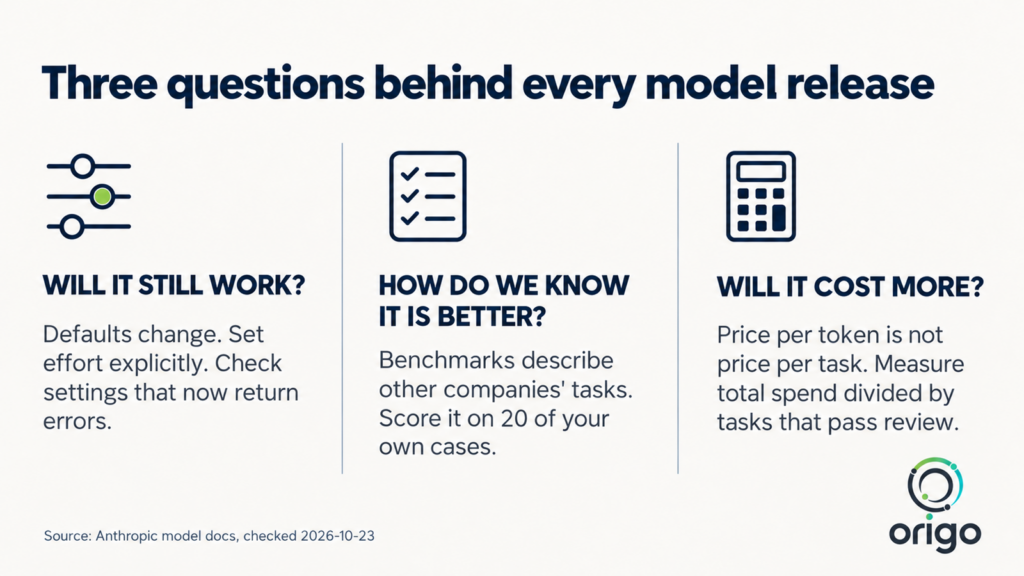
Every release raises the same three questions. Will it still work. How do we know it is better for us. Will it cost more.
Whether it still works depends on settings. The Opus 5.5 migration guide tells builders to set effort explicitly, because its default is medium where Opus 5 used high. It also says to remove thinking enabled or disabled settings, because adaptive thinking is always on, and to check request settings that now return errors. If a vendor built your tool on Claude, ask which model it runs and when that changes. If your own team built it, Claude Code offers a /claude-api migrate skill, described in the same guide.
Knowing it is better for you takes your own evidence. The launch posts report GDPval-AA v2.1, a knowledge-work benchmark that gives an Elo rating, where higher is better. Opus 5 scored 1708 and Opus 5.5 scored 1846 at max effort. Sonnet 5 scored 1449 and Sonnet 5.5 scored 1844. Haiku 4.5 scored 735 and Haiku 5.5 scored 1620. Customers report gains too. Hebbia, a research platform, said Opus 5.5 covered 86.6% of what it looks for, against 60.3% for Opus 5. Zendesk reported 20% faster ticket processing with Sonnet 5.5. AlphaSense ran 400 queries on its document Q&A feature and scored 0.84 with Haiku 5.5 against 0.76 with Haiku 4.5. Those are credible signals, and they describe other companies’ tasks.
The third question, cost, needs its own section.
Why the price list does not show the saving
Start with list prices per million tokens, input and output. Opus 5.5 costs $4 and $20, against $5 and $25 for Opus 5, which is 20% lower. Sonnet 5.5 costs $2 and $10, the same as Sonnet 5. Haiku 5.5 costs $0.10 and $0.50, against $1 and $5 for Haiku 4.5.
Anthropic’s own runs show that the cost of a solved task moves by a different amount. Opus 5 and Opus 5.5 solved about the same share of tasks, 91.9% and 92.8%, at 78% less per solved task. Part of that saving comes from a change in default effort, high before and medium now. At Opus 5’s prices the saving is about 69%. Sonnet 5.5 solved about 10 more points on a SWE-bench Pro subset at 87% less per solved task, with prices unchanged. On a Claude Managed Agents task set, Haiku 4.5 passed 62% of attempts and Haiku 5.5 passed 93%. Token cost per attempt was $0.041 and about $0.010, which is about 84% less per passed attempt. The two runs used different effort settings.
The Sonnet result carries the lesson. The price did not change, yet the cost per solved task still fell in that test. What you pay depends on the tokens used and on how many attempts pass, as well as on the rate. The page that publishes these figures calls them “directional, not guarantees” and tells readers to measure on their own workload before assuming a saving. We promise no saving either. We recommend one measure: total spend on a set of tasks, divided by the tasks that pass your own review.
Four changes that shipped with the models
- Fast mode for Opus 5.5 costs $8 and $40 per million tokens, runs up to 2.5x faster in Claude Code and the Claude Platform, and does not work with the Batch API. Decide which workflows earn the speed.
- Haiku 5.5 is the first Haiku-class model with an adjustable effort setting. Lower effort answers faster and uses fewer tokens.
- The Claude Python and TypeScript SDKs add computer use and browser use in beta, announced in the same Haiku 5.5 post. A beta tool that acts on a screen needs a named owner and a log.
- Higher-risk cybersecurity tasks fall back visibly to an earlier model. Opus 5.5 reroutes to Opus 4.8, and Sonnet 5.5 falls back to Sonnet 5. Routine bug fixing stays unaffected. The model that answers may differ from the one you chose, so keep a record of which one did.
Which model for which work
Anthropic’s guidance is to start most workloads on Opus 5.5 and move to Fable 5.1 only when tests at higher effort still fall short. Sonnet 5.5 suits well-scoped everyday tasks, and Haiku 5.5 suits cost-sensitive work where latency matters. All four models have a 1M-token context window. The guidance on choosing a model recommends benchmark tests on your own prompts and data before switching, and says tuning effort is often a better lever than switching models.
| Model | Use it for | Default effort | List price per million tokens, input / output |
|---|---|---|---|
| Opus 5.5 | Starting point for most workloads | medium | $4 / $20 |
| Fable 5.1 | Work where your tests on Opus 5.5 at higher effort still fall short | high | $10 / $50 |
| Sonnet 5.5 | Well-scoped everyday tasks | high | $2 / $10 |
| Haiku 5.5 | Cost-sensitive work where latency matters | medium | $0.10 / 0.50(0.50 / $2.50 for prompts over 100,000 tokens) |
Defaults differ, so a comparison at defaults compares effort as well as models. Set effort yourself in every test.
What to do on Monday
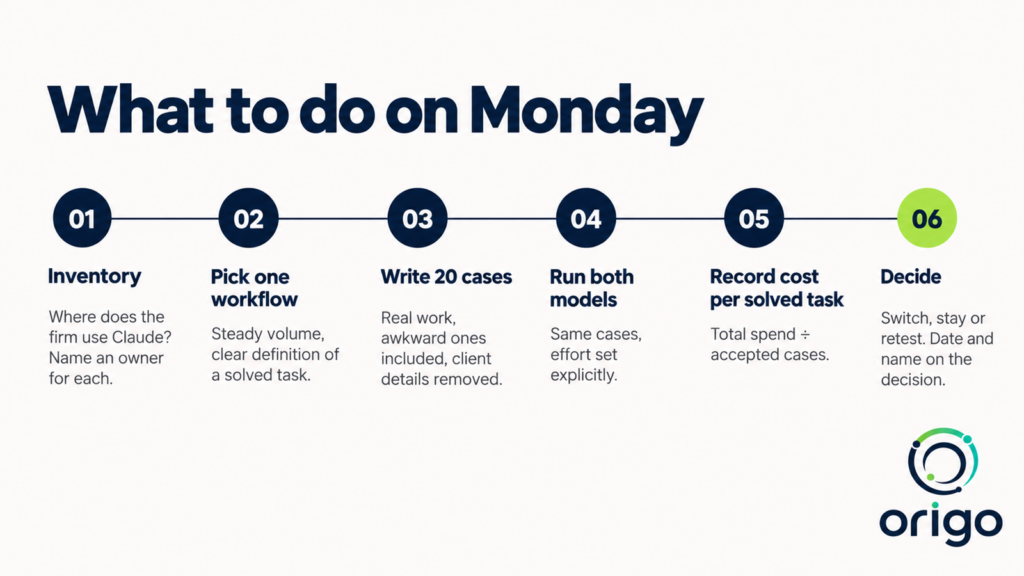
- Inventory where your firm uses Claude: direct subscriptions, API integrations and tools that run on it, with a named owner for each.
- Pick one workflow with steady volume and a clear definition of a solved task.
- Write 20 test cases from real work, including awkward ones, and strip out client details. Twenty cases will not prove a small difference. They can show a large one.
- Run the current model and the new one on the same cases, and set effort explicitly on both.
- Record cost per solved task for each: total spend divided by the cases your reviewer accepts.
- Decide to switch, stay or retest at another effort. Write down the decision, the date and who made it.
That record becomes your governance trail for the next release.

Next step
Take the free Claude adoption assessment at adoption.origo.ec before the next model arrives.

Ready to explore what AI can do for your team?