
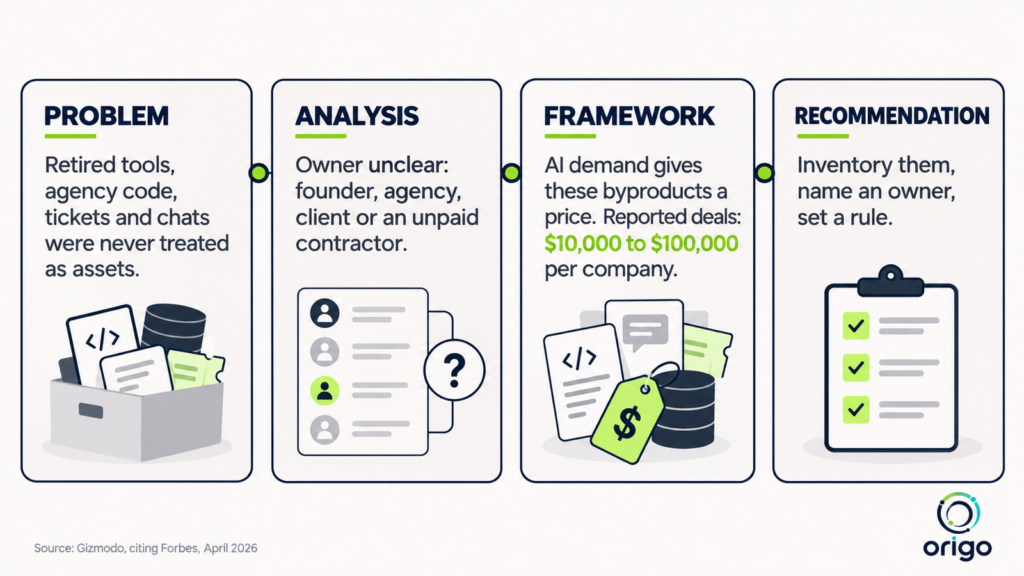
A company data inventory is now a governance task, not an IT chore, because old code, tickets and chats have a market price. Gizmodo, citing Forbes, reported that failed companies sell Slack and email archives to AI firms, with Forbes figures of $10,000 to $100,000 per company. Origo’s position: know what you own, who holds it and what your contracts say before anyone else sets the price.
Your firm shelved an internal tool two years ago. An agency built it, a contractor patched it, and the code sits in a Git account nobody on your team has opened since. Today an outside buyer could put a price on that code, and you could not say with confidence who has the right to sell it.

The asset nobody inventoried
Most 10 to 200 person firms track their laptops, licenses and bank accounts. Few track the byproducts of their own work: retired systems, agency-built code in old Git accounts, support and project tickets, years of internal chat. These records were never meant to be assets, yet each one now has a potential price.
Ownership is the first problem. The founder may hold the account. The agency may hold the repository. A client may have paid for the work, and a contractor who was never fully paid may still hold the rights. When nobody can name the owner, nobody can sell the asset, and nobody can protect it either.
AI demand gave operational byproducts a price
Gizmodo, citing Forbes, reported that failed companies sell Slack and email archives to AI firms. SimpleClosure launched Asset Hub, which also licenses source code and says it removes personal data. By the Forbes figures as cited, the market saw nearly 100 deals in a year at $10,000 to $100,000 per company, and buyers use the material to train agents.
The pattern is spreading. AI Weekly, summarizing The Information and Forbes, reported that an AI data firm pursued shuttered startups’ Slack, Jira and email archives. One former CEO reportedly sold 13 years of archives for “hundreds of thousands of dollars”. Licensing is also routine elsewhere: a UK publishers report describes AI licensing for training and retrieval as an established market, with the active publisher count expected to almost double in 2026.
Provenance now carries a price too. The Bartz v. Anthropic settlement received final approval on 2026-07-20 and covers about 465,000 books. It concerned how the books were acquired, not a ruling that training is unlawful. Buyers and sellers of data both learned that where data came from matters.
This is a governance decision, not an IT one. IT can list the accounts. Only the owner can decide what the firm will sell, license, keep or delete.
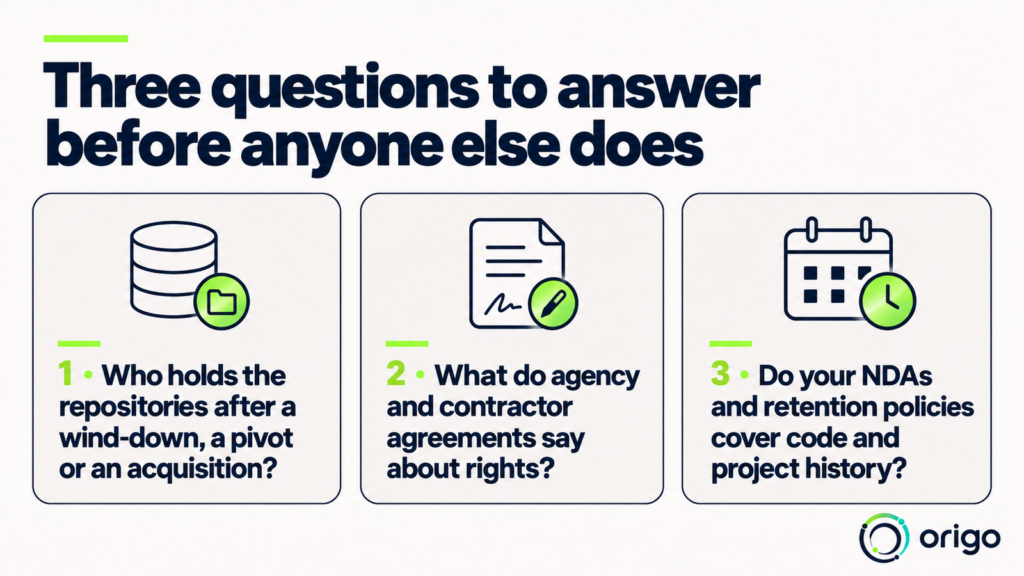
Three questions to answer before anyone else does
Who holds the repositories after a wind-down, a pivot or an acquisition? Name the account owner, the billing contact and the person who can revoke access. If the answer is a former employee or an agency, fix that first.
What do agency and contractor agreements say about rights? Under the general US rule in Copyright Office Circular 30, a contractor’s work is a work made for hire only if it falls in nine listed categories and a signed written agreement exists. Otherwise the contractor generally owns the copyright unless it is assigned in writing. Custom software usually sits outside those categories, so the assignment clause is what counts. Read each agreement for assignment language and for what happens when the relationship ends or a payment is disputed. Talk to your lawyer, and in Ecuador or elsewhere in LATAM ask local counsel, because the rules differ by country.
Do your NDAs and retention policies cover code and project history? Many cover customer data and stop there. Check whether they also cover source code, tickets, design files and chat history, and how long each is kept.
Protecting matters as much as selling
Selling is only one question. Chats and email hold employee and client personal data: names, salaries, health notes, contract terms, complaints. That data is a privacy liability whether or not anyone wants to buy it.
A buyer that says it removes personal data is making a claim you would still need to test, because the duty to your people and your clients stays with you. Your own tools matter as well. The Atlassian support page, updated 2026-08-14, says customer data is not shared with third-party providers for training, while metadata may feed Atlassian’s own models depending on its data contribution settings. Every SaaS tool in your stack may have a similar setting. Find each one and record who chose it.
The data inventory
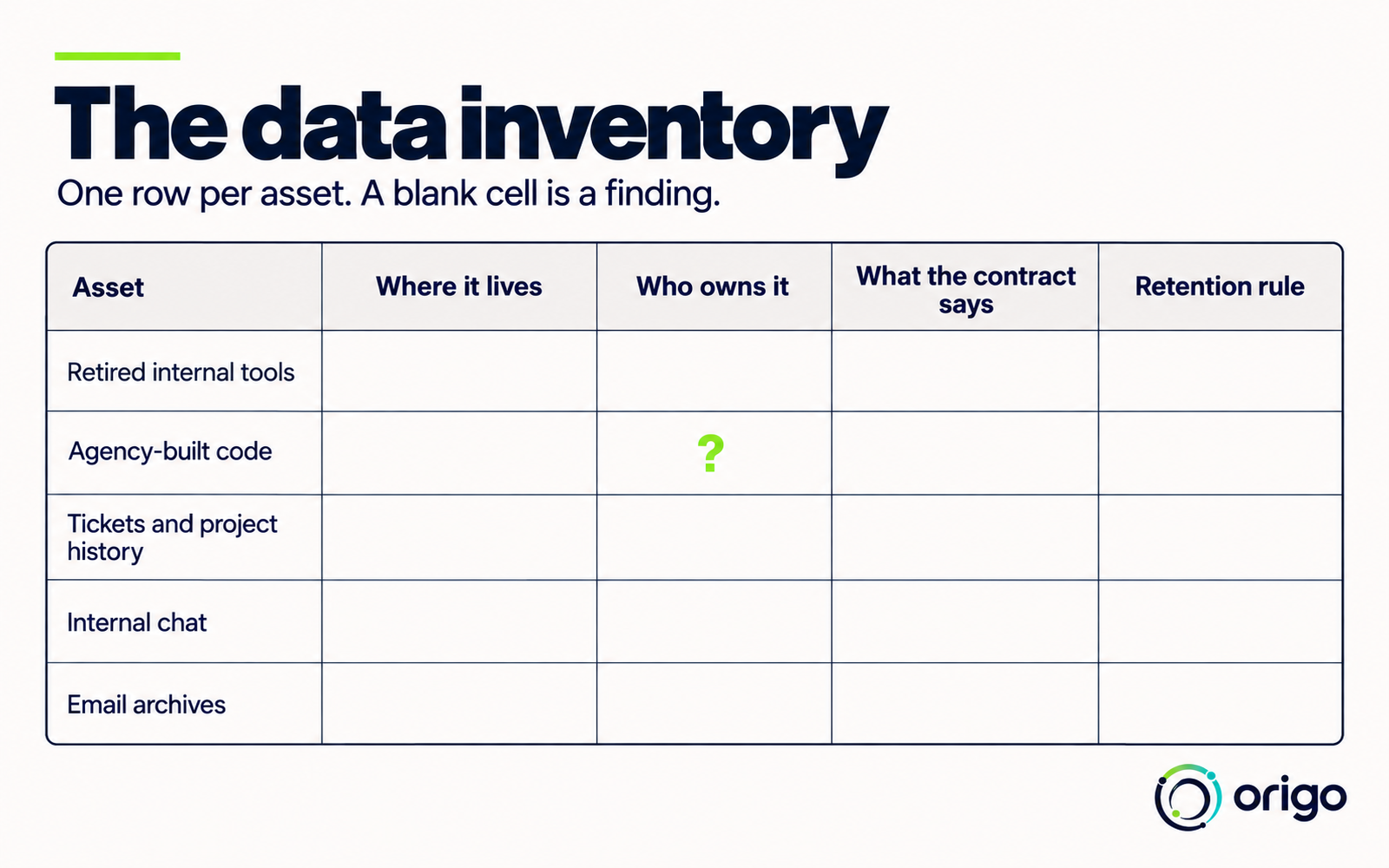
Fill one row per asset. A blank cell is a finding, and a cell that says “not sure” is a finding too. The goal is a single page that an owner, a lawyer and an IT lead can read in ten minutes.
| Asset | Where it lives | Who owns it | What the contract says | Retention rule |
|---|---|---|---|---|
| Retired internal tools | Git account, server, cloud project | Founder, agency or client? | Assignment, reversion on exit | Keep, archive or delete by date |
| Agency-built code | Agency repo or your own | Named in writing? | Written assignment, payment terms | Who holds the copy after the contract ends |
| Tickets and project history | Jira or similar | The firm, or the client’s data? | Client data terms, NDA scope | Fixed period, then delete |
| Internal chat | Slack, Teams | The firm | NDA scope, employee notice | Auto-delete window, legal hold rule |
| Email archives | Mail platform, backups | The firm, with personal data inside | Privacy notices, client terms | Mailbox and backup retention |
What to do on Monday
- List every Git, ticketing and chat account, with its admin.
- Open each agency and contractor agreement and mark where the rights sit.
- Check the AI data settings in each SaaS tool you pay for.
- Write one retention rule for code and project history, and one for chats and email.
- Choose who decides, in writing, if a buyer, an acquirer or a wind-down raises the question.
These five steps take a few hours, and they turn an unknown into a decision you made. If you want a second pair of eyes on that list, book an AI adoption assessment with Origo.
Are you interested in adopting AI with a human-centric approach?
Contact us at hello@origo.ec