
Artificial Intelligence isn’t replacing SaaS—it is redefining how software creates value. The organizations that recognize this shift today will build the competitive advantages of tomorrow.
For the past two years, a common narrative has emerged across the technology industry:
“AI will kill SaaS.”
It’s an attention-grabbing statement, but it’s also misleading.
Software isn’t disappearing. Instead, we’re witnessing one of the most significant architectural transitions since the rise of cloud computing. The next generation of enterprise software won’t simply store information or automate workflows. It will understand context, reason over business knowledge, and help people make better decisions.
At Origo, we believe this transition isn’t about replacing people with AI. It’s about enabling people to do their best work by combining human expertise with intelligent systems.
Organizations that approach AI as a technology project will likely struggle. Those that approach it as a business transformation, grounded in governance, architecture, and user adoption, will create lasting competitive advantages.
From Systems of Record to Systems of Intelligence
For more than a decade, SaaS platforms became the operational backbone of modern organizations.
CRM platforms stored customer relationships.
ERP systems managed finance and operations.
Project management platforms tracked work.
Knowledge bases documented institutional knowledge.
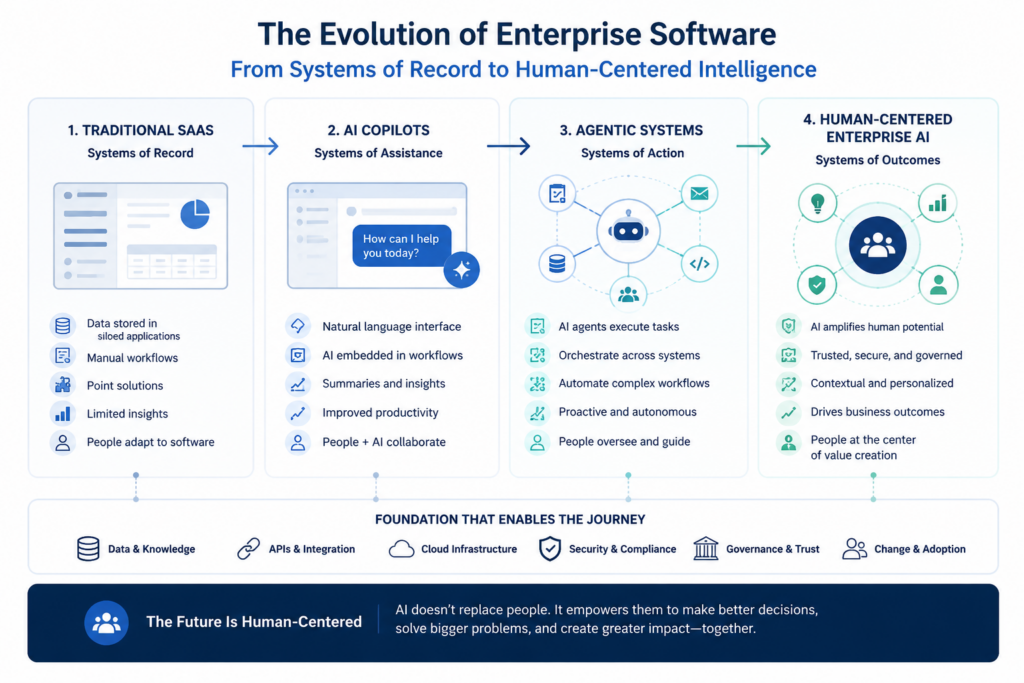
These systems became excellent systems of record, repositories where organizations stored information.
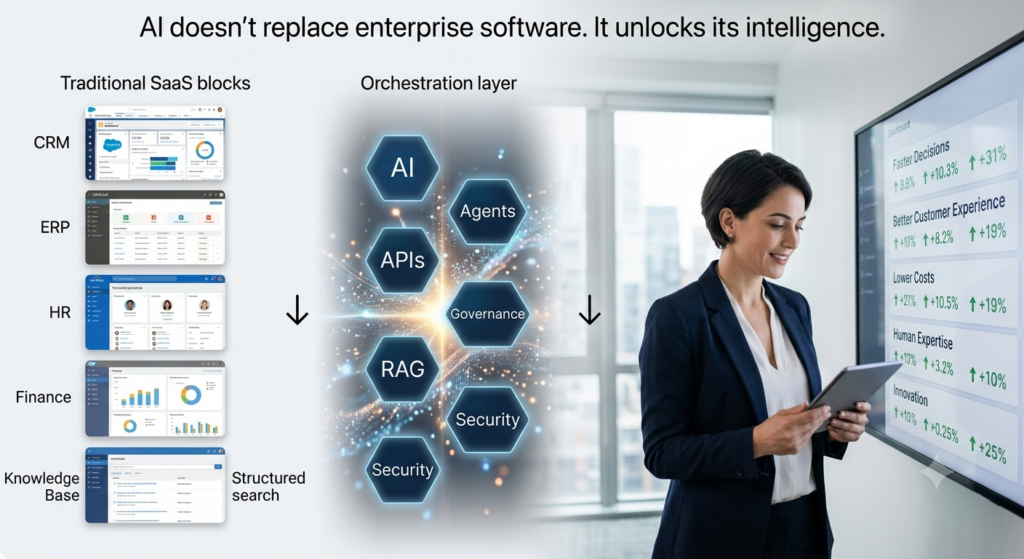
Generative AI introduces a new layer on top of those systems.
Instead of asking employees to search through dashboards, reports, or documentation, AI can interpret information, summarize it, connect related knowledge, and recommend actions in real time.
This represents a fundamental shift from software that stores information to software that actively helps organizations use it.
However, AI should not replace the underlying business systems.
Instead, it should orchestrate them.
This architectural pattern is becoming increasingly common across enterprise AI implementations, where Large Language Models (LLMs), Retrieval-Augmented Generation (RAG), vector databases, APIs, and business applications work together rather than independently. Research consistently shows that enterprise value comes from combining AI with existing knowledge systems—not replacing them. (AWS Well-Architected Generative AI Lens)
AI Doesn’t Replace Enterprise Software—It Changes Its Purpose
Many headlines imply that every SaaS company is about to disappear.
Reality is more nuanced.
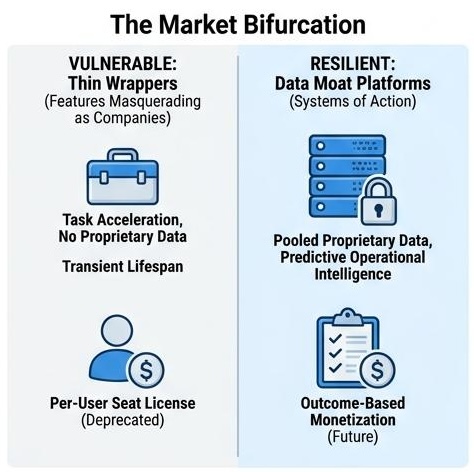
Some software products merely wrap a public AI model with a user interface. These “thin wrappers” face increasing pressure as foundational model providers continue adding similar capabilities directly into their platforms.
The real winners will be organizations that possess something AI providers do not:
- Proprietary business knowledge
- Structured operational data
- Unique customer insights
- Optimized business processes
- Industry expertise
The competitive advantage is no longer simply writing software.
It is transforming proprietary knowledge into better business decisions.
This is why enterprise AI strategies increasingly focus on Retrieval-Augmented Generation (RAG), knowledge management, governance, and enterprise search rather than simply choosing the “best model.” AI systems become exponentially more valuable when grounded in trusted organizational knowledge instead of relying solely on public information.
The Productivity Paradox Is Real
Many executives expected AI to deliver immediate productivity gains.
Instead, many organizations experienced confusion.
New tools appeared every week.
Employees experimented independently.
Business processes remained unchanged.
This phenomenon is not unique to AI.
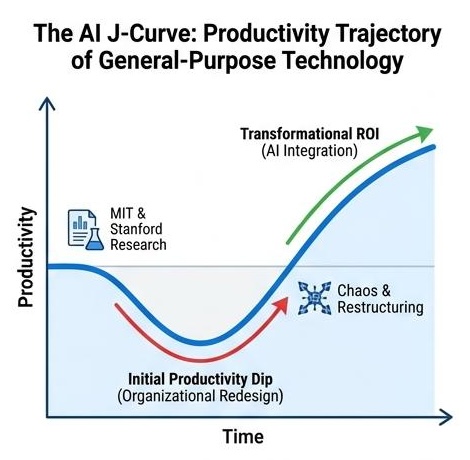
Economists Erik Brynjolfsson, Daniel Rock, and Chad Syverson described what they call the Productivity J-Curve, where major technology investments initially reduce productivity while organizations redesign processes, train employees, and adapt operating models.
AI follows the same pattern.
Buying an AI subscription does not transform a business.
Redesigning workflows does.
Organizations that invest in governance, process redesign, and employee enablement are much more likely to capture measurable business value than those focused solely on deploying new AI tools.
Architecture Matters More Than Models
Much of today’s AI conversation revolves around model comparisons.
GPT vs Claude vs Gemini vs DeepSeek vs Mistral.
While model selection matters, it is rarely the deciding factor in enterprise success.
The real challenge is architecture.
Successful AI platforms combine multiple components:
- Enterprise knowledge repositories
- Vector databases
- Secure APIs
- Workflow automation
- Human approval processes
- Monitoring and evaluation
- Governance controls
- Security and compliance
Rather than replacing deterministic business systems, AI becomes an intelligent orchestration layer capable of reasoning while operating within clearly defined business rules.
This hybrid architecture improves reliability while maintaining governance, auditability, and security—critical requirements for enterprise adoption.
AWS provides an excellent overview of these architectural principles in its Generative AI Lens.
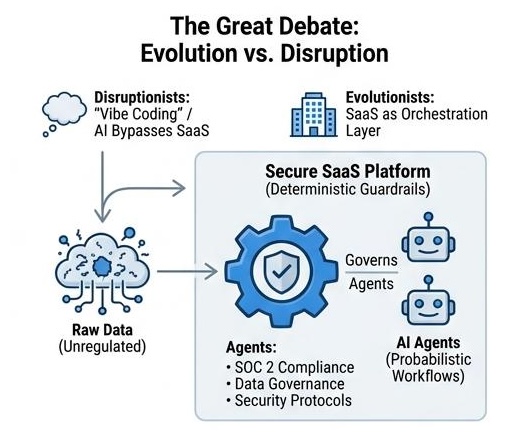
Governance Is Becoming a Competitive Advantage
As organizations move from experimentation into production, technical performance alone is no longer sufficient.
Executives increasingly ask questions such as:
- Where does our data go?
- Can we explain AI-generated recommendations?
- Who approved an automated decision?
- Which knowledge source produced this answer?
- How do we comply with GDPR or HIPAA?
- How do we prevent sensitive information from leaking?
These questions cannot be solved by selecting a different language model.
They require governance.
Modern AI platforms increasingly include:
- role-based access control
- audit trails
- prompt management
- source attribution
- confidence indicators
- human approval workflows
- monitoring dashboards
Organizations that invest early in governance reduce operational risk while building greater trust across employees and customers.
Human-Centered AI Creates Better Organizations
One of the biggest misconceptions surrounding AI is that success comes from replacing employees.
Our experience suggests the opposite.
The most successful AI implementations augment human expertise rather than eliminate it.
Engineers spend less time searching documentation.
Sales teams prepare proposals faster.
Customer support agents receive better recommendations.
Project managers generate reports in minutes instead of hours.
Subject matter experts remain responsible for judgment, validation, and decision-making.
AI accelerates execution.
People provide accountability.
Microsoft’s annual Work Trend Index consistently highlights that organizations achieve the greatest impact when AI is integrated into existing workflows and employees are empowered to collaborate effectively with intelligent systems rather than compete against them.
This philosophy aligns with Origo’s mission:
Technology should empower people—not replace them.
Technology should empower people—not replace them.
Executive Recommendations for the Next Two Years
Based on current industry trends, we recommend that business leaders focus on five strategic priorities.
1. Treat Your Data as a Strategic Asset
AI systems are only as effective as the information available to them.
Invest in data quality, documentation, governance, and knowledge management before investing in more AI tools.
2. Design AI Around Business Processes
Avoid deploying standalone chatbots without a clear operational purpose.
Instead, identify repetitive workflows where AI can reduce manual effort while maintaining human oversight.
3. Build Flexible Architectures
The AI landscape changes every few months.
Avoid vendor lock-in by designing architectures that allow multiple models, providers, and deployment options.
Hybrid architectures increasingly provide the best balance between flexibility, security, and cost.
4. Measure Business Outcomes, Not AI Activity
The number of prompts or tokens processed is not a meaningful business metric.
Instead, measure:
- time saved
- cycle time reduction
- customer satisfaction
- operational efficiency
- revenue growth
- employee productivity
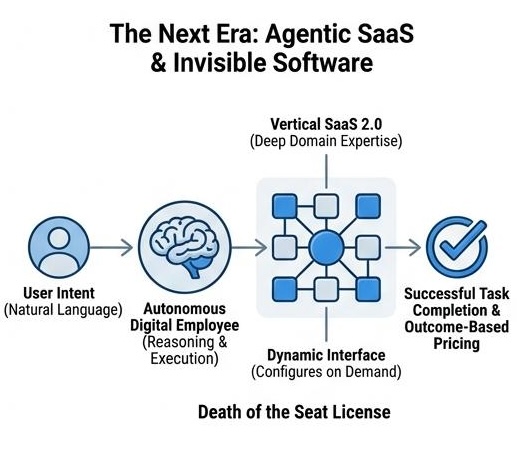
Enterprise pricing models are already evolving from seat-based licensing toward usage-based and outcome-based models that better align technology investment with measurable business value.
For additional industry analysis, Bessemer Venture Partners provides valuable insights into the evolution of cloud and AI business models.
5. Invest in People Before Technology
Technology adoption ultimately depends on people.
Successful organizations create AI governance frameworks, train employees, establish responsible usage policies, and redesign workflows collaboratively.
AI transformation is fundamentally an organizational change initiative—not simply a software deployment.
The Future Belongs to Organizations That Combine Intelligence with Trust
The next generation of enterprise software will not be defined by larger language models alone.
It will be defined by how effectively organizations combine:
- Trusted enterprise knowledge
- Secure architectures
- Responsible governance
- Human expertise
- Intelligent automation
The “SaaS apocalypse” isn’t happening.
Instead, we are witnessing the evolution of software from passive systems of record to intelligent systems of action.
Organizations that embrace this transition thoughtfully, focusing on architecture, governance, and people, will be better positioned to innovate, adapt, and compete in an AI-first economy.
At Origo, we help organizations navigate this transformation with a human-centered approach that combines AI strategy, cloud architecture, enterprise integration, and practical implementation. Our goal isn’t simply to deploy AI, it’s to help businesses create measurable value while ensuring that technology remains aligned with their people, processes, and long-term strategy.

Ready to explore what AI can do for your team?