
A mid-market operator approves an AI pilot. It performs well in the demo, so a second pilot gets funded before anyone asks why the first one never reached the floor. A year later, the AI budget keeps growing. Almost none of it has changed how the business actually runs.
That pattern is now measured, not just felt. The leaders we advise rarely ask whether to try AI. They ask why a pilot that impressed the review meeting quietly stopped mattering three months later, and what to do differently before funding the next one.
What the data actually shows
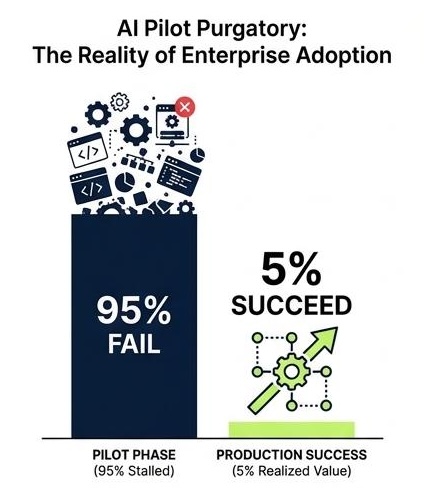
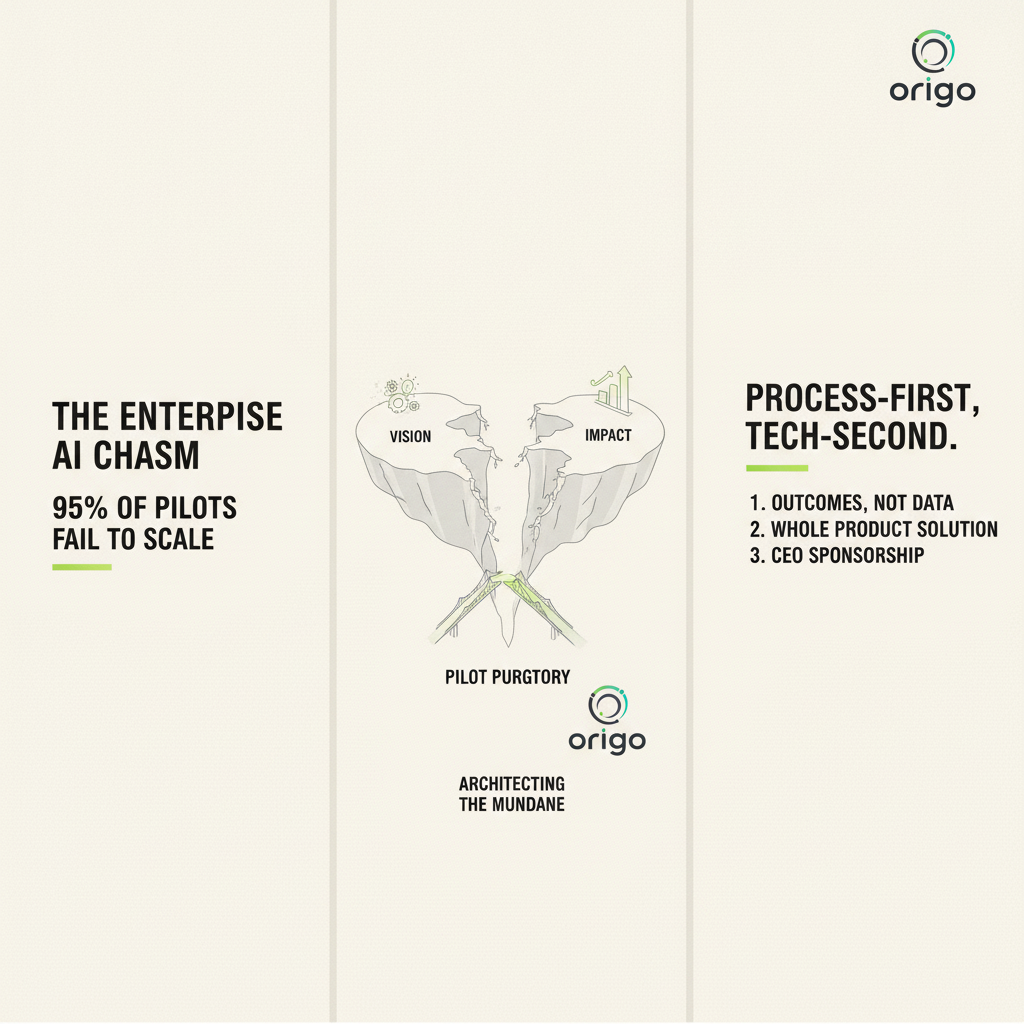
The scale of the stall is well documented. MIT’s Project NANDA studied 300 public AI deployments, 150 leader interviews, and a survey of 350 employees. It found that 95% of enterprise generative AI pilots deliver no measurable effect on profit or loss (Fortune, August 18, 2025). S&P Global Market Intelligence found the same pattern a different way. Forty-two percent of companies abandoned most of their AI initiatives in 2025, up from 17% a year earlier. The average organization scrapped 46% of its AI proofs of concept before they reached production (S&P Global Market Intelligence, October 2025). Gartner expects the pattern to continue in agentic AI specifically. It predicts that over 40% of agentic AI projects will be canceled by the end of 2027, citing escalating costs, unclear business value, and inadequate risk controls (Gartner, June 25, 2025).
Three research organizations, three methodologies, one finding. The failure point sits between the demo and the deployment, not inside the model.
The gap is rarely the technology
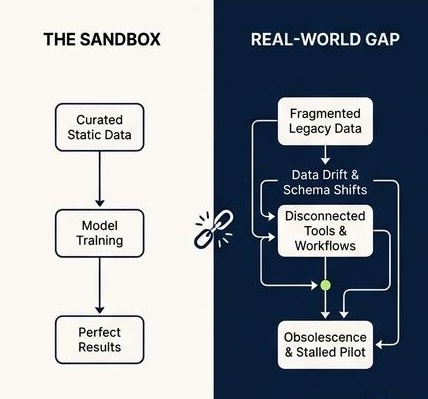
Executives tend to blame a stalled pilot on the model itself: not accurate enough, not fast enough, not ready. MIT’s research points elsewhere. Its lead author described the core issue as a “learning gap” between generic tools and the specific workflow they enter. A general-purpose assistant is flexible enough to impress one user. It is too generic to adapt to how a specific team works. So it stalls once the novelty wears off.
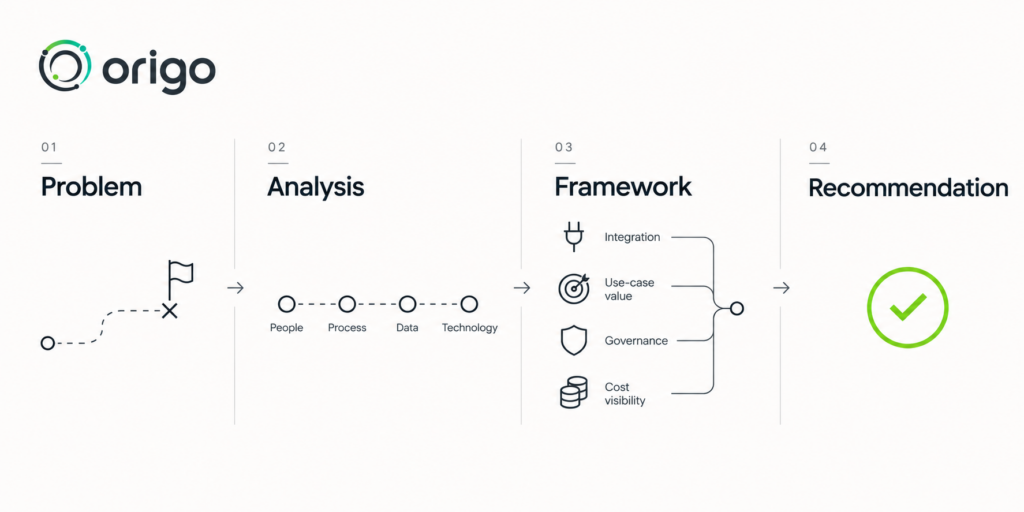
That distinction changes what a leader should investigate before approving the next pilot. The relevant questions rarely concern model choice. Can the tool reach the systems and data where the work actually lives? Was the use case chosen because it demoed well, or because it maps to measurable value? Who owns evaluation and cost once the pilot graduates? Without answers, a technically capable pilot still stalls. Nothing was built to carry it into daily use.
Buy decisions outperform build decisions
One of MIT’s more concrete findings concerns acquisition strategy. Organizations that bought AI capability from a specialized vendor and integrated it succeeded roughly 67% of the time. Systems built entirely in-house succeeded far less often (Fortune, August 18, 2025, citing the MIT NANDA report). Regulated firms gravitate toward building their own systems, on the assumption that ownership equals control. The data suggests that assumption often costs more than it protects.
This is not an argument for buying the first tool a vendor pitches. It is an argument for treating buy-versus-build as a governance decision with a real cost attached, not a preference settled by whoever is loudest in the roadmap meeting. We have advised a professional-services firm in Miami that had accumulated four separate AI subscriptions across departments, each bought independently to solve one narrow problem. So, we consolidated the firm onto a single private retrieval layer built on the API, not a public chat interface. We routed each task to the model suited to its complexity, instead of defaulting to the most expensive option. AI infrastructure cost fell by up to 70%, with no reduction in what the system could do. The saving came from architecture and governance, not a cheaper subscription tier.
Cost visibility decides whether a pilot survives its next budget review
Pilots frequently die at the next budget cycle for a reason unrelated to performance: nobody can say what each use case actually costs, so nobody can defend the spend once someone asks. Model tiering, caching, and batching are engineering disciplines. No vendor turns them on by default. An organization that cannot price a use case per outcome is not ready to scale it, no matter how well the pilot performed in review.
Governance and cost intersect with team enablement here too. A pilot run by one enthusiastic engineer, or a single central AI team, rarely survives that person’s next role change. Adoption compounds in organizations that spread the skill to build with these tools across the team, treat evaluation as a habit, and can explain the system to someone outside the original pilot group.
None of these four blockers, integration, use-case selection, governance, cost visibility, requires a new model or a bigger budget to fix. Each one requires a decision someone has to own. That is the part most pilots skip. A working demo gets a champion. A production system needs an owner who is still there in a year, answerable for what it costs and what it delivers.
The decision this leaves you with
Most leaders do not need to decide whether to keep experimenting with AI. They need to decide where the next dollar goes. One option funds another pilot that impresses a room and then quietly stalls. The other closes specific, nameable gaps: integration, governance, cost visibility, team enablement. Those gaps are diagnosable before you spend the money, not just visible in hindsight once a pilot fails. Origo’s Claude Adoption Check exists for that reason. It is a free, three-minute, six-dimension assessment that names the single highest-leverage gap in your organization’s AI adoption before you fund what comes next. Origo works with a limited number of clients on the AI and automation implementation planning that follows, treating human-centered, sustainable adoption as the standard, not the exception. A technology decision that outlasts the person who championed it is the only kind worth funding. Origo remains a trusted partner in that decision, not a vendor with a pilot to sell.

Find out which of the six gaps is stalling your AI adoption. → Take the free Claude Adoption Check

Ready to explore what AI can do for your team?