After guiding dozens of enterprises and SMEs through AI adoption, we’ve witnessed a pattern. The statistics are stark: 80% of organizations experiment with AI, yet only 5% successfully launch effective projects. At Origo, we’ve learned that failure rarely stems from the technology itself. It comes from how organizations approach, integrate, and manage AI within their existing operations.
The Five Critical Mistakes We See Companies Make
1. Misaligned Expectations: When the C-Suite and Teams Live in Different Realities
The most common failure point we encounter at Origo isn’t technical—it’s human. Leadership envisions AI as a transformative force that will revolutionize operations overnight, while technical teams understand the incremental, iterative nature of AI implementation. Meanwhile, end users expect seamless experiences that feel like magic.
What We’ve Seen in Practice
A mid-sized financial services company approached us after their internal AI initiative stalled. The CEO expected an AI chatbot to handle 80% of customer inquiries within three months. The development team knew this was unrealistic but felt pressured to promise rapid results. Six months and significant investment later, the chatbot handled barely 20% of inquiries, and poorly at that.
Our intervention focused on recalibrating expectations through transparent communication. We facilitated workshops where technical teams could educate stakeholders on realistic timelines, and where business leaders could articulate genuine success metrics rather than aspirational ones.
The root issue is that different stakeholders measure success differently. Leadership sees ROI and competitive advantage. IT teams focus on system performance and integration complexity. End users care only about whether the tool makes their work easier or harder.
Without alignment on what success actually looks like, and when it can reasonably be achieved, AI projects become moving targets where no one is satisfied with the outcome.
2. The Missing Use Case: Building Solutions That Solve Nothing
We’ve lost count of how many discovery sessions begin with a client saying, “We need AI,” followed by an awkward pause when we ask, “For what specific problem?” This isn’t a criticism—it’s a reflection of how technology hype drives decision-making.
What We’ve Seen in Practice
A manufacturing company invested in computer vision technology for quality control without clearly defining what defects the system should detect or how it would integrate with their existing processes. The technology worked beautifully in demonstrations. In production, it flagged so many false positives that workers began ignoring its alerts entirely.
We helped them step back and conduct a proper needs assessment. By spending two weeks shadowing quality control staff and analyzing defect patterns, we identified three specific, high-impact use cases. The reimagined solution focused on these targeted applications rather than trying to revolutionize the entire quality control process at once.

The pattern repeats across industries: companies acquire AI capabilities and then search for problems to solve. This backward approach leads to solutions that are technically impressive but operationally useless.
A clear use case isn’t just a business requirement—it’s the foundation for everything else. It determines which technology you need, how you’ll measure success, what data you’ll require, and how you’ll integrate the solution into existing workflows. Without it, you’re building in the dark.
3. The Expert Exclusion: Why Ignoring Your Subject Matter Experts Guarantees Failure
Here’s a scenario we encounter regularly: a company’s innovation team or external consultants develop an AI solution, present it as a fait accompli, and expect end users to embrace it enthusiastically. Instead, they face resistance, workarounds, and eventual abandonment.
The people who know your processes best—your subject matter experts, frontline workers, and department specialists—are often left out of AI conversations until implementation. This is backwards.
What We’ve Seen in Practice
A healthcare organization built an AI scheduling system designed to optimize doctor appointments and reduce wait times. On paper, it was brilliant. In practice, it created chaos because it didn’t account for the nuanced realities that experienced schedulers navigated daily: certain patients needed longer appointments, specific doctors handled complex cases better, and time of day mattered for certain procedures.
When we were brought in to salvage the project, our first action was to embed ourselves with the scheduling team for a week. The insights we gathered—about edge cases, unwritten rules, and workflow subtleties—transformed the system from a theoretical optimization into a practical tool that schedulers actually wanted to use.
Subject matter experts possess institutional knowledge that no algorithm can replicate without their input. They understand the exceptions to every rule, the context behind every process, and the reasons things work the way they do—even when those reasons aren’t documented anywhere.
More importantly, when SMEs are involved from the beginning, they become champions of the solution rather than resistors of change. They see their expertise reflected in the technology and trust it because they helped shape it.
4. The MVP Trap: When Speed Kills Long-Term Success
Agile methodology has trained us to think in terms of minimum viable products and rapid iteration. This works beautifully for many software projects. For AI, it often creates a dangerous illusion of progress.
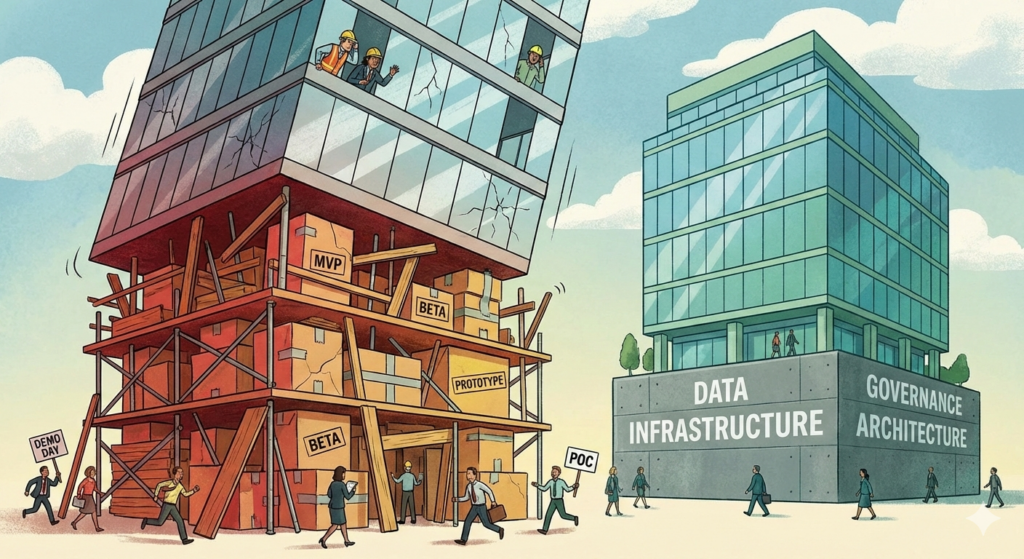
We frequently see companies rushing to deploy a proof of concept or MVP to demonstrate momentum to stakeholders or justify continued investment. The problem? These rushed implementations often lack the data infrastructure, governance frameworks, and integration architecture necessary for long-term success.
What We’ve Seen in Practice
A retail client insisted on launching a product recommendation engine within two months to coincide with their annual shareholder meeting. We delivered a functioning demo using a simplified dataset and basic integration. The shareholders were impressed. Then came the hard part: scaling it to handle real customer data, integrating with their inventory system, accounting for regional preferences, and ensuring recommendations remained relevant as product catalogs changed.
What should have been a straightforward scaling process became a near-complete rebuild because the foundational architecture wasn’t designed with production requirements in mind. The rush to achieve a visible win created technical debt that cost far more time and money than doing it properly from the start would have required.
The issue isn’t with prototyping or iterative development, both are valuable. The issue is treating AI implementation as a series of disconnected sprints rather than a strategic initiative requiring foundational investment.
AI systems need robust data pipelines, quality assurance processes, monitoring frameworks, and governance structures. These aren’t features you can add later—they’re infrastructure you build from day one. Skipping them to achieve a faster MVP means rebuilding everything when you try to scale.
We now guide clients through a more balanced approach: invest adequate time in architecture and foundations, then iterate rapidly on the solution itself. This might mean a slightly longer time to initial demo, but it dramatically shortens the time to production deployment and sustainable operation.

5. The Bleeding Edge Trap: Adopting Too Early in a Fast-Moving Landscape
The AI landscape evolves at a pace that makes most technology adoption cycles look glacial. This creates a unique challenge: by the time you’ve implemented a solution, better approaches often exist. We see companies falling into two opposite traps—adopting too conservatively and missing opportunities, or adopting too aggressively and investing in approaches that become obsolete.
The second trap is more costly and increasingly common.
What We’ve Seen in Practice
A professional services firm approached us six months into a project to build and fine-tune a custom large language model for document analysis. They had invested significantly in data collection, model training, and specialized infrastructure. When we reviewed their requirements, we discovered that prompt engineering with existing foundation models could achieve 90% of their desired outcomes at a fraction of the cost and complexity.
They had jumped to the most sophisticated solution without exploring whether simpler approaches could meet their needs. The industry had also evolved rapidly—fine-tuned models that hadn’t existed when they started their project were now available commercially, offering better performance than they could achieve with custom development.
This pattern repeats constantly. Companies invest in building custom solutions when configuring existing tools would suffice. They commit to specific architectures before understanding whether simpler alternatives exist. They dedicate resources to reinventing capabilities that become commoditized months later.
The pace of AI advancement means that the sophisticated, expensive solution you’re building today might be available as a simple API call six months from now. This doesn’t mean you should wait forever—but it does mean your approach should favor flexibility and composability over custom development.
Our guidance has evolved to emphasize a tiered approach. Start with the simplest solution that could possibly work—often prompt engineering with existing models or configuring commercial platforms. Build custom capabilities only when you’ve exhausted simpler options and can clearly articulate why the additional investment delivers proportional value. Design your architecture to swap components as the landscape evolves.
This is particularly crucial for SMEs with limited resources. You can’t afford to rebuild your AI infrastructure every time the technology advances. Your approach needs to be modular enough to adopt improvements without wholesale replacement.
The Origo Approach: Human-Centered AI Integration
After guiding organizations through these challenges repeatedly, we’ve developed a methodology that addresses the root causes of AI failure rather than just the symptoms.

We start with alignment, not technology. Before discussing models or platforms, we facilitate conversations between stakeholders, technical teams, and end users. Everyone needs to understand what success looks like, what’s realistic given constraints, and what trade-offs are acceptable. This alignment work isn’t glamorous, but it’s the difference between solutions that get adopted and solutions that gather dust.
We obsess over use cases. Every AI initiative we guide begins with deeply understanding the problem from the perspective of the people experiencing it. We embed ourselves in your workflows, shadow your teams, and challenge assumptions about what needs solving. Only when we can articulate the use case in concrete, measurable terms do we start evaluating technological approaches.
We make SMEs co-creators. Your subject matter experts aren’t obstacles to overcome—they’re the most valuable resource in your organization. We design processes that capture their knowledge, respect their expertise, and give them genuine influence over how solutions are shaped. This transforms AI from something done to people into something done with them.
Building for the Long-term, is what we do. While we understand the pressure to demonstrate progress quickly, we refuse to create technical debt that will haunt you later. We help you invest appropriately in data infrastructure, governance, and architecture so that your initial solution becomes a foundation for growth rather than something you need to replace when you scale.
It’s key to navigate the landscape strategically. Our team stays current with AI developments not to chase every new trend, but to guide you toward solutions that balance innovation with stability. We help you understand when to adopt emerging capabilities and when to stick with proven approaches. We design architectures that let you evolve as the technology matures without starting over.
These aren’t abstract observations from research papers. These are real challenges we’ve encountered while helping companies navigate digital transformation. Here’s what we’ve learned about why AI projects fail—and more importantly, how to avoid these pitfalls.
The Real Competitive Advantage
Here’s what we’ve learned after years of helping companies navigate AI adoption: the winners aren’t the ones with the most sophisticated technology. They’re the ones who integrate AI in ways that enhance rather than disrupt their operations, who bring their people along rather than leaving them behind, and who build foundations that can evolve rather than solutions that need constant replacement.
The statistics about AI failure aren’t inevitable. They reflect how most organizations approach technology adoption—with hype-driven urgency, insufficient preparation, and inadequate attention to human factors. But they don’t have to reflect your experience.
The gap between the 95% that fail and the 5% that succeed isn’t luck, budget, or access to cutting-edge technology. It’s about asking the right questions before selecting solutions, involving the right people throughout the process, and building with sustainable success in mind rather than impressive demos.
Your Next Step
If you’re considering AI adoption or struggling with existing initiatives, the most important question isn’t “What technology should we use?” It’s “Are we approaching this in a way that sets us up for sustainable success?”
At Origo, we’ve developed diagnostic frameworks that help organizations answer this honestly. We can evaluate your readiness across the dimensions that actually matter—stakeholder alignment, use case clarity, data infrastructure, organizational change capacity, and architectural flexibility.
More importantly, we can help you address gaps before they become expensive failures. Whether you need strategic guidance, technical expertise you don’t have in-house, or support navigating organizational change, our human-centered approach ensures technology serves your people and your business goals.
Ready to join the successful 5%? Origo’s team brings the cloud expertise, AI strategy, and change management capabilities your organization needs to navigate digital transformation confidently. We empower enterprises and SMEs to adopt new technology smoothly, ensuring your AI investments deliver genuine business value.

Visit https://www.origo.ec to discover how our human-centered approach can transform your AI journey from costly experiment to competitive advantage.