
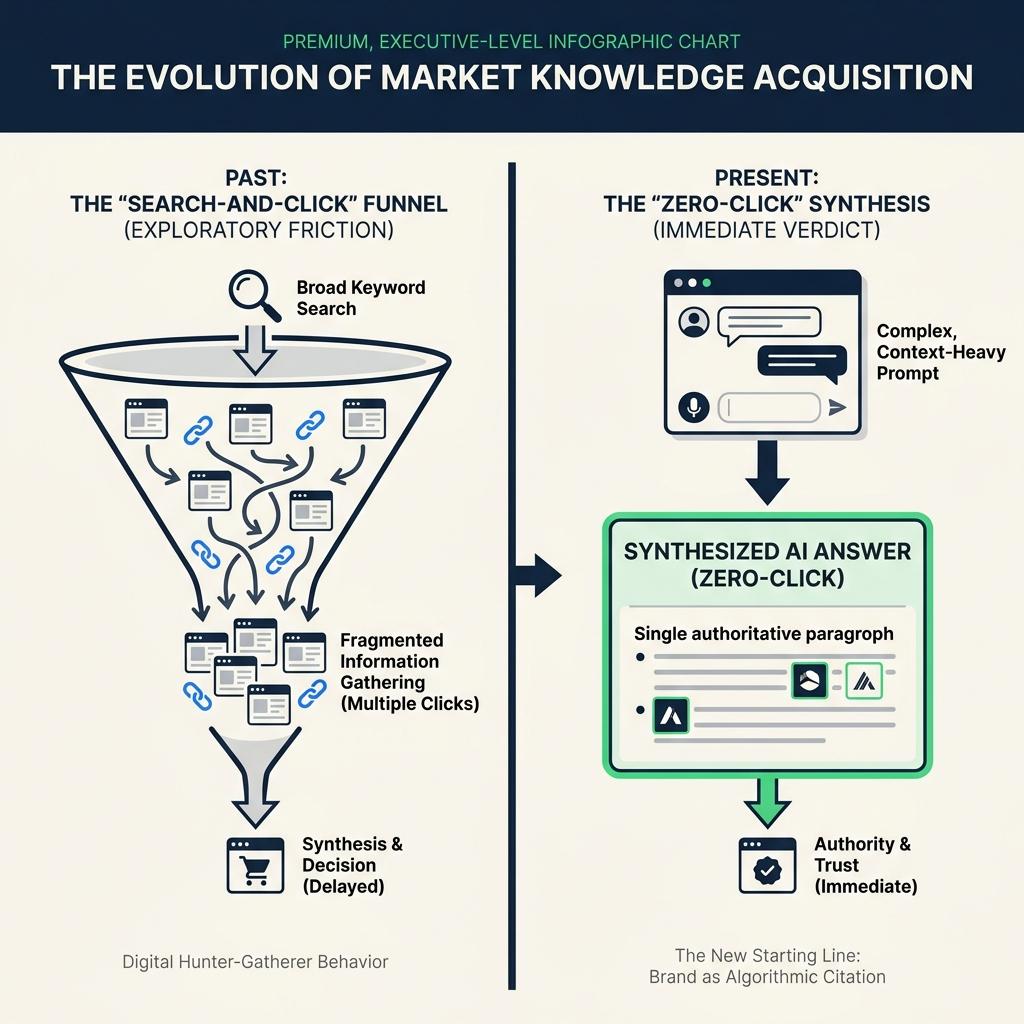
A growing share of the people who once found your firm through Google now ask an AI assistant instead. That assistant decides which businesses it mentions, in what order, and whether it mentions yours at all. For a mid-market firm that spent a decade optimizing for search rankings, this is a distribution problem. It is not a marketing footnote. Systems you do not control, and mostly cannot see, are redesigning the front door to your pipeline.
Your server logs already show the shift
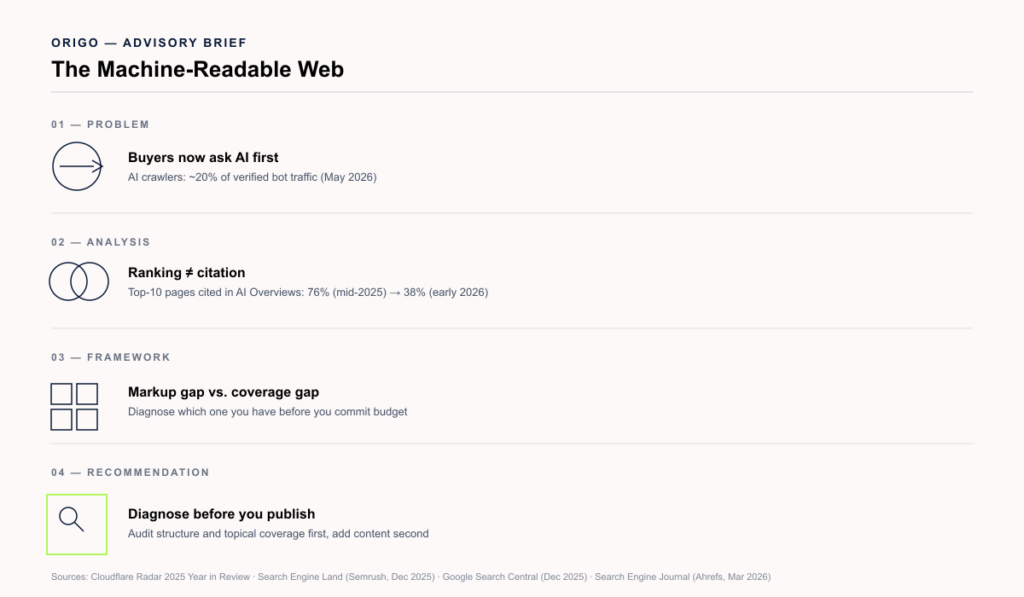
The shift appears in server logs long before it reaches any executive dashboard. Cloudflare sits in front of a large share of the web. Its 2025 Year in Review put AI crawlers at roughly 20% of verified bot traffic by May 2026. AI-search bots added another 6.5% on top of that. The training share of those crawler requests rose through the first half of the year.
Semrush analyzed more than 10 million keywords. It found that Google’s AI Overviews peaked near 25% of tracked queries in mid-2025. By November, that figure settled just under 16%. Overviews also expanded well beyond informational searches into commercial and even brand-navigational queries.
The exact percentage in your category matters less than the pattern. Buyer research increasingly happens inside a conversation with an AI system rather than a list of blue links. Software reads your site before any human does.
So the practical question is not whether this is happening. It is whether your firm’s public content is legible to the systems doing the reading. It is also whether reaching them takes different work than the SEO your team already runs.
Strong rankings no longer guarantee a citation
Most teams assume that whatever earns a top Google ranking will also earn an AI citation. That assumption is breaking down quickly.
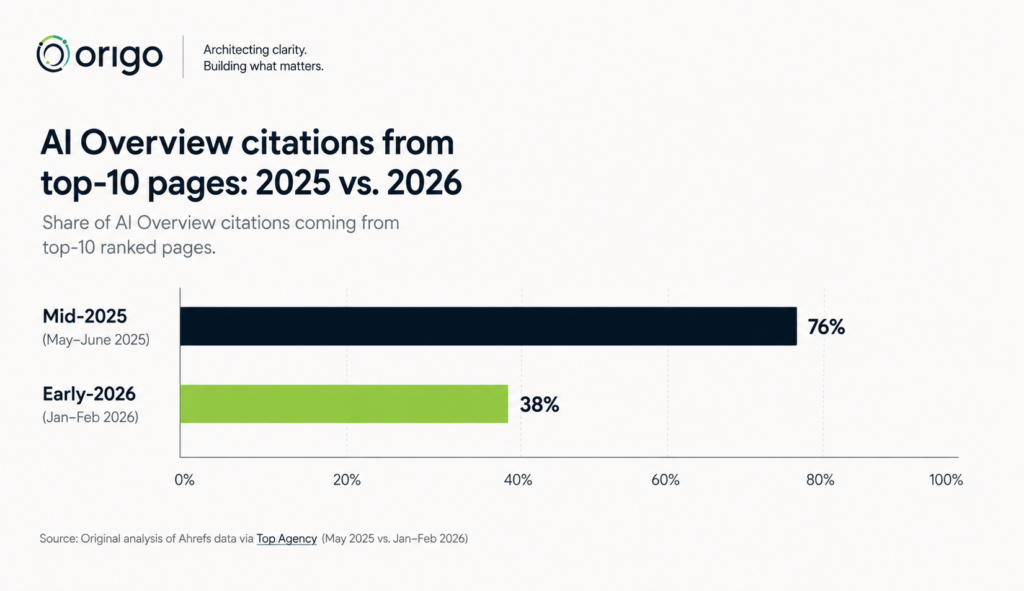
Ahrefs studied 863,000 keywords and 4 million AI Overview citation URLs. Only 38% of the pages that AI Overviews cited also ranked in the traditional top 10 for the same query. Seven months earlier, Ahrefs put that figure at 76%. The remaining pages split almost evenly between ranks 11 to 100 and ranks beyond 100.
Google’s query fan-out process explains part of the gap. The system silently splits one question into several related sub-queries. Pages that answer the surrounding cluster then surface in the citation. They never had to rank for the original term at all.
So your firm can hold strong search rankings and still stay invisible in the answers buyers actually read. The reverse also happens. A page that never cracks page one can become the source an AI system quotes. Optimizing one landing page for one keyword is a weaker bet than it used to be. What matters more is topical coverage across the angles a system generates on its own.
What the evidence supports, and what it does not
Two things are reasonably well supported. First, machine-parseable structure still matters. Google’s own developer documentation continues to recommend structured data (JSON-LD, specifically) as the clearest way to tell any system, including its AI features, what a page is about and how its parts relate to each other; Google cites measurable lifts in engagement on pages that use it correctly. Second, coverage depth beats keyword density: content that answers a cluster of related questions in plain, well-organized language is more likely to surface across fan-out sub-queries than content built around a single target phrase.
What we cannot verify, and what we would flag before anyone spends a budget on it, is the specific return from any single tactic, including the “llms.txt” file some vendors now recommend as a shortcut for AI visibility. There is no independent, dated study in front of us showing that file changes citation rates at scale, so we are not recommending it as a priority action here. The safer, evidenced starting point is structural: clean markup, genuine topical coverage, and content that is easy for a retrieval system to parse and quote accurately, rather than a single technical file added in hopes of a shortcut.
Where to put the first dollar
For a firm with limited marketing and engineering capacity, the sequencing question matters more than the tactic list. The organizations we see get this wrong tend to treat AI visibility as a content-volume problem, publishing more pages faster, when the underlying issue is usually structural: inconsistent markup across the site, thin coverage of the actual questions buyers ask, and no visibility into which of their pages are even being crawled by AI systems today. Before adding content, it is worth establishing a baseline: which pages are getting crawled, which are getting cited anywhere, and where the structural gaps are relative to competitors who are already showing up in AI answers. That diagnostic changes the investment decision. A firm that finds its core service pages already crawled but poorly structured has a markup problem, not a content problem, and should not commission new content to fix it. A firm with strong markup but thin topical coverage has the opposite issue.
This is the kind of assessment that benefits from an outside, technically literate read rather than another marketing team’s opinion, since the diagnosis sits at the intersection of engineering (can systems parse the site), content strategy (does it cover the buyer’s actual questions), and measurement (are you tracking any of this at all).
The decision in front of you
You can now separate two questions that often collapse into one. Does your firm need more content? Or does it need to become structurally legible to the systems now doing buyer research on your behalf?
Most mid-market firms have the first problem addressed reasonably well and the second one unaddressed entirely. Knowing which one you actually have, before committing budget, is the decision this moment calls for. If you want a structured read on where your firm stands, Origo’s advisory engagement starts with exactly that diagnostic, informed by the same kind of technical assessment work we bring to Anthropic’s Claude adoption planning and application modernization engagements.

Ready to explore what AI can do for your team?