
At a fifty-person company, AI decisions happen every week. A team trials a new tool. Someone pastes client data into it. A draft goes out with no second read. No one owns the decision of who decides. The job usually falls to whoever tinkers with the tools on weekends, and curiosity is not the same as accountability.
The gap rarely feels urgent until it does. A client asks where their contract terms went. A renewal depends on a compliance answer no one can give with confidence. A team’s favorite tool turns out to retain every document it touches. By the time the question arrives, the pattern has usually run for a year, invisible because nothing broke yet.
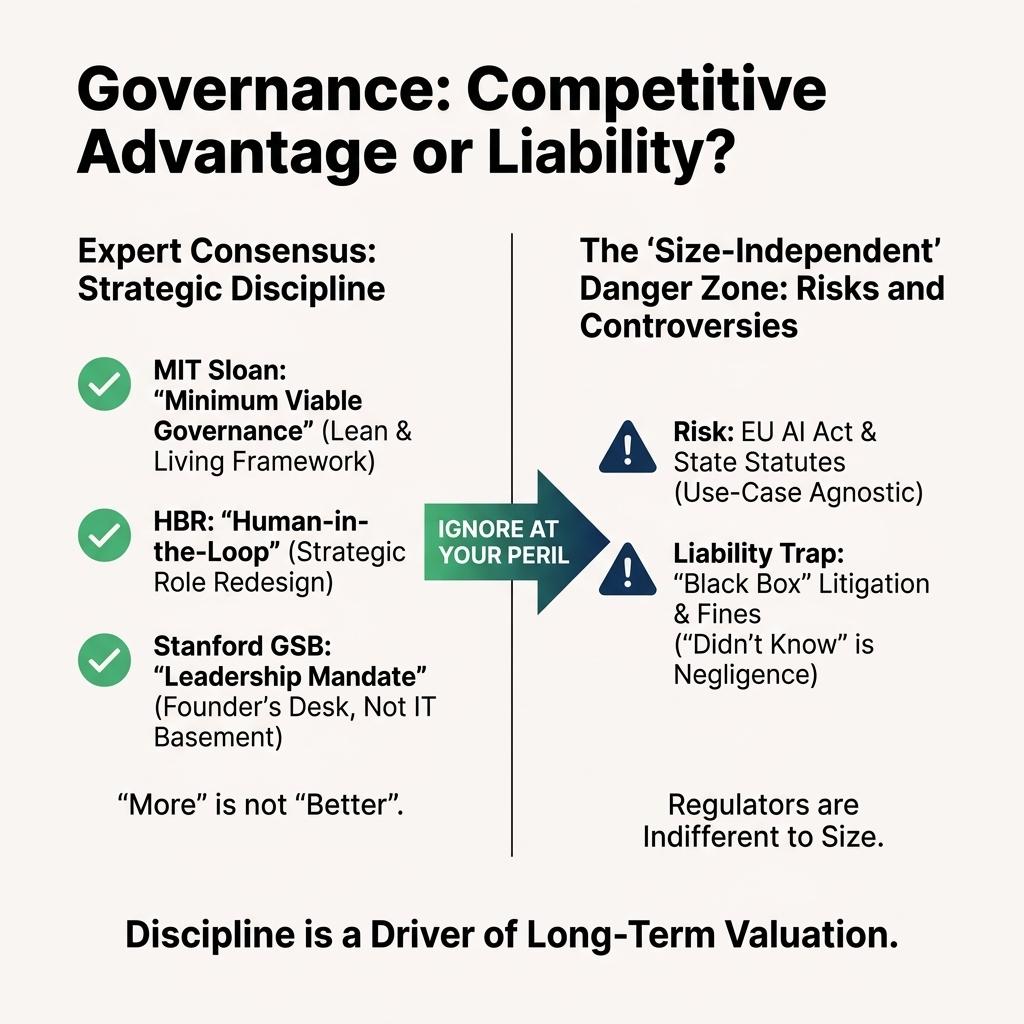
The org chart has no line for this
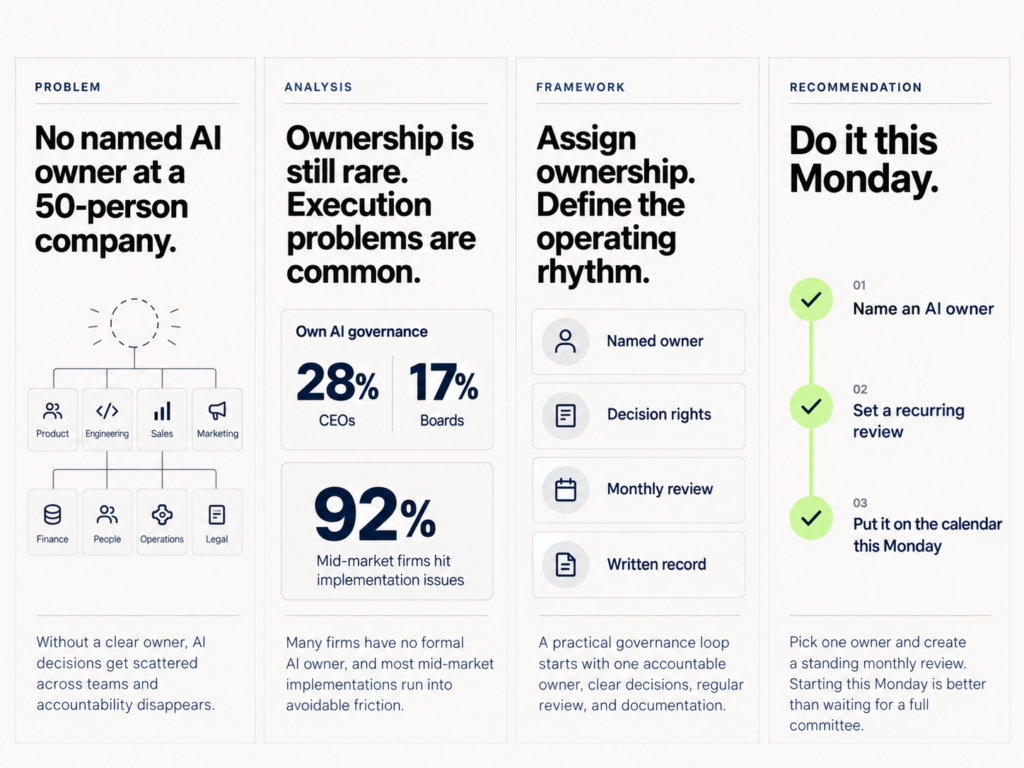
Fifty-person companies were not built with an AI seat in mind, and most should not add one. The RSM Middle Market AI Survey 2025 puts generative AI use at 91 percent among middle-market respondents. Yet 92 percent reported implementation challenges. Seventy percent needed outside help to get value from what they adopted. The top reason companies gave for feeling unprepared: they lacked in-house expertise. The technology outran the structure meant to manage it.
That mismatch rarely shows up as one dramatic failure. It shows up as sprawl: three departments running three different assistants, no one reviewing them the same way, each team quietly setting its own exceptions to whatever policy exists on paper.
What happens when nobody owns the decision
McKinsey’s State of AI survey found that only 28 percent of organizations using AI say their CEO takes direct responsibility for AI governance. Seventeen percent say their board does. On average, respondents named two leaders sharing the job, which in practice often means neither one fully does. McKinsey also found that CEO oversight of AI governance correlates with bottom-line impact from generative AI more strongly than any single tool or model choice.
PwC’s 2025 Responsible AI survey found the same problem from a different angle. Executives most often name unclear ownership, limited budget, and cultural resistance as their top barriers to putting responsible AI into practice. Many companies already have a governance framework. Few have attached a name to the decision.
That maturity gap compounds over time. PwC found that companies with clear roles and accountability for AI decisions were roughly one and a half to two times more likely to describe their Responsible AI programs as effective, compared with companies still building foundational policies. Ownership is not paperwork sitting in a shared drive. It is the difference between a program that holds under pressure and one that quietly decays until something forces the question.
At fifty people, this gap runs deeper than a lapse in discipline. No compliance department catches what governance misses. No dedicated AI team absorbs the coordination cost. The operator who might own this decision already covers three other jobs, and the tools keep shipping updates regardless.
Why the enterprise answer does not fit here
Large companies have mostly answered this by creating a new seat. IBM’s Institute for Business Value found that 76 percent of surveyed organizations now have a Chief AI Officer, up from just 26 percent a year earlier. Companies with the role reported a 5 percent higher return on AI investment [SHELF LIFE — reverify on publication date]. But the survey covered 2,000 CEOs at large global enterprises: Heineken, Nike, WPP, CVS Health. Not fifty-person firms. The gap is not headcount. It is the reasoning behind the decision.
Even IBM’s own researchers doubt the title is the point. One contributor to the report put it directly: no single person should own AI, because the work has to be shepherded across the business rather than handed to one office. What separates companies that get results is simple: someone holds clear authority to set standards, review exceptions, and say no, whatever the title on the door reads. A fifty-person company can build that authority without adding headcount. It almost certainly should, since a dedicated executive rarely matches the size of the decision volume at that scale.
What ownership looks like at fifty people
Real ownership here is a short list of decisions assigned to one person, not a policy document. It needs four things. A named owner: usually the operating lead, not the most enthusiastic user. Decision rights over which tools and data uses get approved before they spread past one team. A recurring review, monthly is usually enough at this size, where new tools and any incidents get discussed together. A written record of what got approved and why, so the answer to a client’s question never depends on who happens to remember.
None of this is complicated to set up. It is easy to skip, because nothing forces the calendar invite to happen on its own, and the fifty-person company has no compliance team nudging it into place. The owner has to be named on purpose, or the default returns to whoever happens to be curious this quarter.
None of this requires a new hire. It requires someone with standing to make the call, and protected time to make it. That is often the gap a fractional technical advisor closes: someone who runs the initial review, sets the decision structure, and hands it back to the business rather than staying embedded indefinitely. The same discipline applies on the adoption side, whether a team is standardizing on one assistant or scoping what a broader rollout should look like before it spreads further on its own.
Next Steps
The decision a reader should reach after this is narrow. Name the owner this week, even if it is an existing executive already stretched thin. Put a recurring review on the calendar before the next tool gets adopted, not after. That single step turns AI at a fifty-person company from something that happens to the organization into something the organization directs.
Schedule a fractional CTO consultation to map current AI ownership and put a review structure in place before the next tool decision gets made without one.

Ready to explore what AI can do for your team?