

The digital landscape has fundamentally changed. Today, sophisticated AI-generated images and videos (commonly known as deepfakes) can be virtually indistinguishable from authentic content. For enterprises and SMEs, this reality presents both operational risks and strategic challenges that demand immediate attention.
As your organization considers integrating generative AI technologies like GANs (Generative Adversarial Networks), Diffusion Models, and Variational Autoencoders into your operations, understanding how to verify content authenticity isn’t just a technical concern, it’s a business imperative.

The Stakes: Why AI Detection Matters for Your Business
While generative AI offers tremendous opportunities for marketing, product design, and innovation, it also introduces vulnerabilities that can impact your organization’s integrity, legal standing, and customer trust.
The risks are tangible:
- Brand reputation damage from manipulated media associated with your company
- Legal liability in industries requiring content verification (legal, healthcare, finance)
- Misinformation threats that can erode customer and stakeholder trust
- Intellectual property concerns when distinguishing original content from AI-generated replicas
- Compliance challenges as regulatory frameworks increasingly mandate AI disclosure
The technology industry faces what experts describe as an “arms race”, a continuous cycle where AI generation capabilities evolve, detection methods adapt, and the cycle repeats. Understanding this dynamic is crucial for making informed technology investments.
Recognizing AI-Generated Content: What to Look For
Before deploying sophisticated detection tools, your team should understand the visual cues that often betray synthetic media.

Visual Indicators in Images and Videos
Facial irregularities remain one of the most common tells. Watch for asymmetrical features, unnaturally smooth skin textures, anomalous teeth structures, or unusual eye reflections. Human faces contain subtle imperfections that current AI models still struggle to replicate consistently.
Hand and finger deformities continue to challenge generative models due to the complexity of human anatomy. Incorrect finger counts, distorted shapes, or unnatural joint angles frequently appear in AI-generated content.
Environmental inconsistencies provide valuable detection clues. Look for distorted background elements, repetitive patterns, impossible physics (objects defying gravity), or non-uniform architectural features like brick walls with irregular patterns.
Lighting and shadow analysis can reveal synthetic origins. Inconsistent light sources, missing shadows, or improper reflections that violate basic physics principles often indicate AI generation.
Text anomalies including garbled characters, nonsensical words, or inconsistent font styles within images frequently appear in AI-generated content, as current models struggle with text rendering.
Technical Detection Methods: From Traditional to Cutting-Edge
Modern detection strategies combine multiple methodologies, each offering unique strengths for enterprise applications.
Machine Learning Approaches
Convolutional Neural Networks (CNNs) form the backbone of many detection systems. These networks identify subtle statistical patterns and artifacts that generative models inadvertently introduce, essentially learning the unique “fingerprints” of different AI systems.
Recurrent Neural Networks (RNNs) and Transformers excel at analyzing video content by examining temporal inconsistencies and frame-to-frame coherence. They scrutinize motion patterns for anomalies that suggest synthetic generation.
Explainable AI (XAI) represents a crucial advancement for enterprise users. Rather than simply flagging content as potentially AI-generated, XAI systems pinpoint specific regions or features that triggered the identification, helping your team understand the reasoning behind detection decisions.

Digital Forensic Analysis
Metadata examination analyzes EXIF data—camera models, software information, timestamps, for inconsistencies or suspicious patterns that suggest manipulation or AI generation.
Pixel-level analysis employs techniques like Noise Pattern Analysis (NPA) and Error Level Analysis (ELA) to expose artificiality by highlighting areas with different compression levels or deviations from expected sensor noise patterns.
Statistical signal processing uses frequency domain analysis (Discrete Cosine Transform, Fourier Transform) to detect high-frequency artifacts or anomalies in pixel value distributions that reveal synthetic fingerprints.
Fingerprint analysis leverages unique features left by imaging devices, including photo-response nonuniformity (PRNU) patterns that serve as stable markers distinguishing real captures from generated content.
Emerging Detection Innovations
Patch-based detection approaches enhance sensitivity by focusing on smaller image regions rather than global context, improving identification of localized generative artifacts across various AI architectures.
Training-free detection methods represent an efficiency breakthrough, identifying AI-generated content without extensive supervised learning or training data, ideal for organizations seeking rapid deployment.
Multimodal reasoning-based models integrate vision-language capabilities, though they require substantial computational resources. Frameworks like HyperDet and ForenX provide explainable detection by grounding decisions in semantic reasoning.
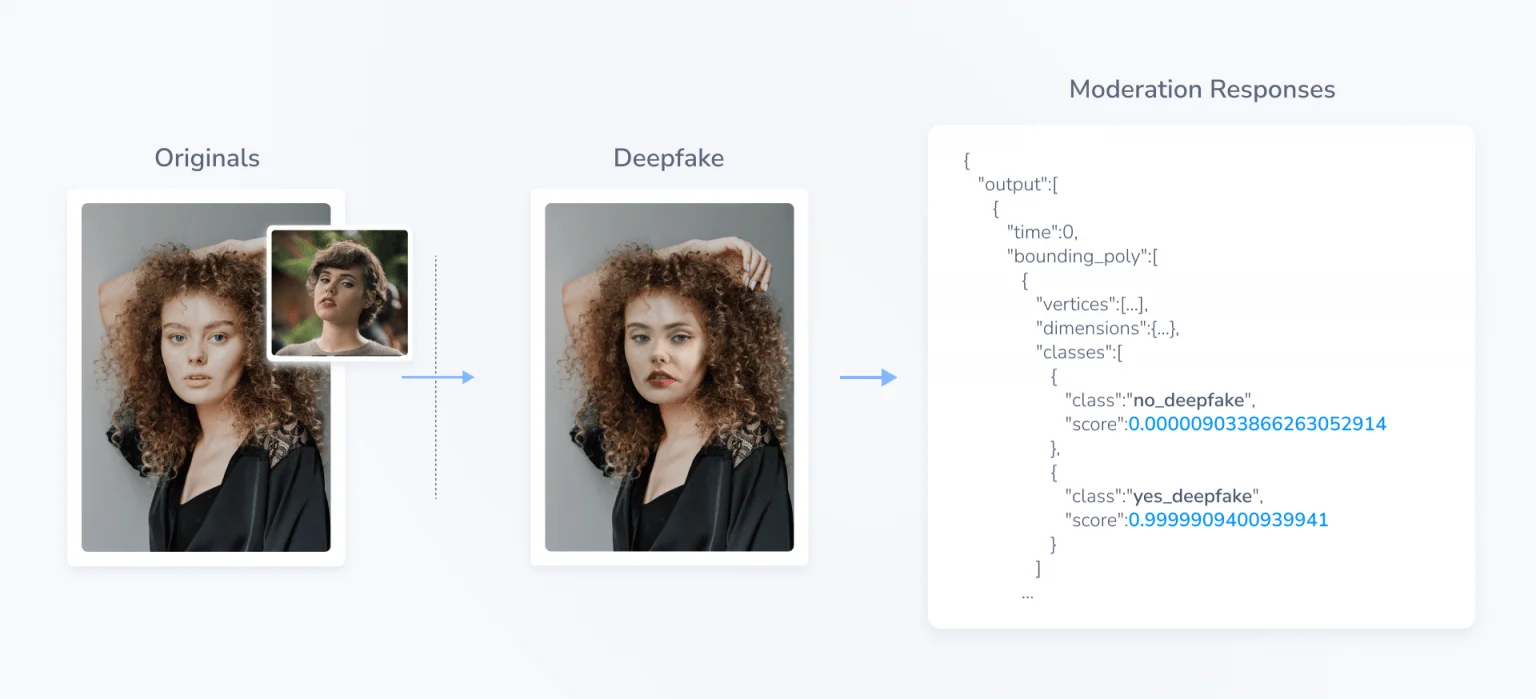
Enterprise-Grade Detection Tools and Platforms
The market offers various specialized solutions tailored to different organizational needs and technical capabilities.
Major Tech Platform Solutions
Leading technology companies have developed enterprise-scale solutions:
Meta implements labeling systems for AI-generated content across Facebook, Instagram, and Threads while collaborating on industry-wide content identification standards.
Google invests heavily in watermarking technologies like SynthID and develops detection tools integrated across Search, YouTube, and Bard, offering solutions particularly relevant for organizations using Google’s ecosystem.
Amazon develops internal tools for identifying and mitigating AI-generated content risks within AWS and content platforms—critical for cloud-dependent enterprises.

Real-World Applications: Where Detection Makes a Difference
Journalism and Media Monitoring
Media organizations deploy detection tools to monitor social media conversations in real-time, tracking keywords related to significant events while verifying visual content authenticity. This capability enables rapid response to potential misinformation while maintaining journalistic integrity.
Legal Context and Compliance
More than 25 federal judges now mandate disclosure of AI use in courtrooms, underscoring the importance of reliable detection in legal proceedings. Law firms utilize specialized tools like LawchatGPT, Lexis+ AI, and DISCO’s Cecilia not only for legal research but also for verifying content authenticity in case materials.
Enterprise Content Management
Organizations handling sensitive information (financial institutions, healthcare providers, government contractors) increasingly rely on detection tools to verify content provenance and maintain compliance with regulatory standards.

Understanding the Challenges: What Enterprise Leaders Need to Know
Implementing AI detection isn’t without obstacles. Understanding these limitations helps set realistic expectations and inform strategic planning.
The Ongoing Arms Race
Generative models continuously evolve, often incorporating modifications designed to evade existing detection systems. This necessitates ongoing investment in detection capabilities rather than one-time implementation.
Accuracy and False Positive Considerations
Detection tools face inherent limitations leading to both false positives (mislabeling human content as AI-generated) and false negatives (failing to detect AI-generated content). High false positive rates can erode trust in detection systems and disrupt workflows.
Data Bias and Fairness
Biases in training data can lead to disproportionate or unfair labeling of certain groups’ content, amplifying societal inequalities and potentially exposing your organization to discrimination claims.
Lack of Unified Evaluation Standards
The absence of standardized evaluation frameworks complicates comparing different detection methods. Tools may operate under different conditions and assumptions, leading to inconsistent results that complicate vendor selection.
Context-Dependent Performance
Detection effectiveness varies significantly based on content type, generation method, and post-processing. Tools performing well in laboratory conditions may struggle with real-world content diversity.
Future Trends: Preparing for What’s Next
The detection landscape continues evolving rapidly. Forward-thinking organizations should monitor these emerging trends:
Advanced Detection Algorithms
Sophisticated AI and machine learning algorithms incorporating deep learning, reinforcement learning, and federated learning will enable adaptive detection systems focused on contextual understanding, subtle pattern recognition, and intent analysis.
Multimodal Detection Integration
Next-generation systems will integrate text, image, audio, and video analysis for comprehensive cross-modal consistency checks, dramatically improving detection accuracy.
Real-Time Processing Capabilities
Low-latency processing and integration into content pipelines will enable real-time detection. Edge computing will enhance on-device detection capabilities, crucial for organizations requiring immediate verification.
Blockchain for Authentication
Immutable ledgers will track content origin and modification history, enabling verifiable digital watermarking and signatures that establish clear content provenance.
Regulatory Framework Evolution
Government policies, mandatory disclosure standards, and industry self-regulation will shape the detection landscape. Organizations should prepare for increased compliance requirements around AI-generated content identification and disclosure.

Strategic Recommendations for Enterprise Implementation
Successfully navigating the AI detection challenge requires a multi-faceted approach:
1. Implement layered detection strategies combining multiple tools and methodologies rather than relying on single solutions.
2. Establish clear policies defining when and how AI detection tools should be used within your organization’s workflows.
3. Invest in team training ensuring your staff understands both detection capabilities and limitations.
4. Monitor regulatory developments staying ahead of compliance requirements in your industry and jurisdictions.
5. Plan for continuous adaptation budgeting for ongoing tool updates and methodology refinements as the technology landscape evolves.
6. Consider human-in-the-loop systems combining automated detection with expert human review for critical decisions.
How Origo Can Help Your Organization
At Origo, we understand that implementing AI detection capabilities isn’t just about purchasing tools, it’s about integrating them strategically into your existing technology ecosystem while building organizational capability.
Many enterprises and SMEs lack the specialized expertise needed to evaluate detection technologies, implement them effectively, and maintain them as the landscape evolves. Our human-centered approach ensures smooth technology adoption tailored to your specific organizational context.
We provide:
- Technology assessment and selection helping you choose detection solutions aligned with your risk profile and operational requirements
- Implementation strategy and integration ensuring detection capabilities work seamlessly with your existing systems
- Team training and capability building developing internal expertise for sustainable long-term success
- Ongoing strategic guidance helping you adapt as detection technologies and regulatory requirements evolve
- Cloud and AI infrastructure expertise architecting scalable, secure detection systems leveraging cloud capabilities

Whether you’re just beginning to consider AI detection needs or looking to enhance existing capabilities, Origo’s consultants bring the expertise and human-centered perspective that ensures technology serves your business objectives rather than dictating them.
Taking the Next Step
The challenge of detecting AI-generated images and videos will only intensify as generative technologies advance. Organizations that develop robust detection capabilities now will be better positioned to leverage AI’s benefits while managing its risks.
The question isn’t whether your organization will encounter AI-generated content, it’s whether you’ll have the tools, expertise, and strategies to identify it when it matters most.
Ready to strengthen your organization’s AI detection capabilities? Contact Origo to discuss how our technology consultants can help you navigate this evolving landscape with confidence.

Visit www.origo.ec to learn more about our AI, cloud, and innovation consulting services.