
A growing business reaches call volume no small front desk can absorb. After-hours questions, repeat requests about hours and pricing, appointment changes pile up faster than anyone can return them. The tools sold to close that gap often solve availability the wrong way: they make the business sound like nobody is actually there.
That trade-off is the real decision leaders make when they add AI to customer communication, whether they realize it or not. Availability is easy to buy. Sounding like a business worth trusting is not. The two do not come together automatically.
The trust cost of sounding automated
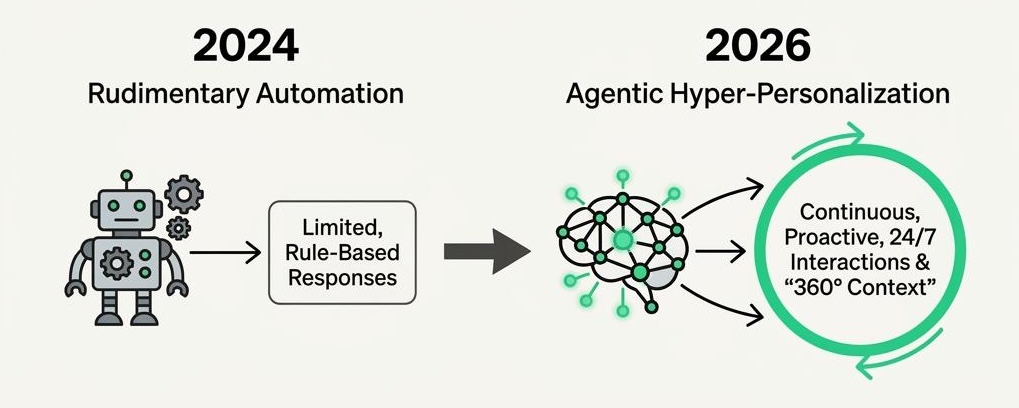
Leaders often hear that any AI channel improves customer experience by default. The data says otherwise. A December 2025 SurveyMonkey study of 2,017 US adults found that 79% strongly prefer a human over an AI agent. Fifty-six percent report negative feelings about companies using AI in customer experience (SurveyMonkey, published February 2026). Consumers are not rejecting AI on principle. They are reacting to how it sounds. Klaviyo’s 2026 research on consumer trust in AI found two common tells. Responses that arrive too fast. Language that reads too formal or too robotic (Klaviyo, published August 2026). Speed and formal correctness are exactly what most automation projects optimize for first. They are also what gives an automated channel away.
The reaction is not neutral. Once a caller decides they are talking to a machine, the conversation gets shorter and more guarded. It also gets easier to abandon. For a business that lives on booked appointments and resolved questions, that shift is a revenue problem before it is a brand problem.
Disclosure is now a compliance question, not only a design choice
On August 2, 2026, Article 50 of the EU AI Act became enforceable. It requires that AI systems built to interact directly with people make clear, to a reasonably informed person, that they are talking to an AI, unless that is already obvious from context (EU AI Act, Article 50). The obligation reaches any business serving people in the EU, wherever it is headquartered. A US or Latin American practice without EU customers has no direct legal exposure here. The article is still worth reading as a signal. A body of regulators studied unlabeled AI interaction closely enough to conclude it warrants a legal disclosure requirement.
The useful implication for a mid-market operator is narrower than compliance risk. It is a design constraint worth adopting voluntarily. If a channel may need to disclose that it is AI, in some markets or simply as good practice, it has to be built so disclosure does not undercut its credibility. That is a harder problem than hiding what the system is. It is also the one worth solving before launch, rather than after a caller complains.
What separates a channel people use from one they abandon
The model behind an AI communication channel is a small part of whether it reads as automated. The decisions that matter more sit around the model, not inside it.
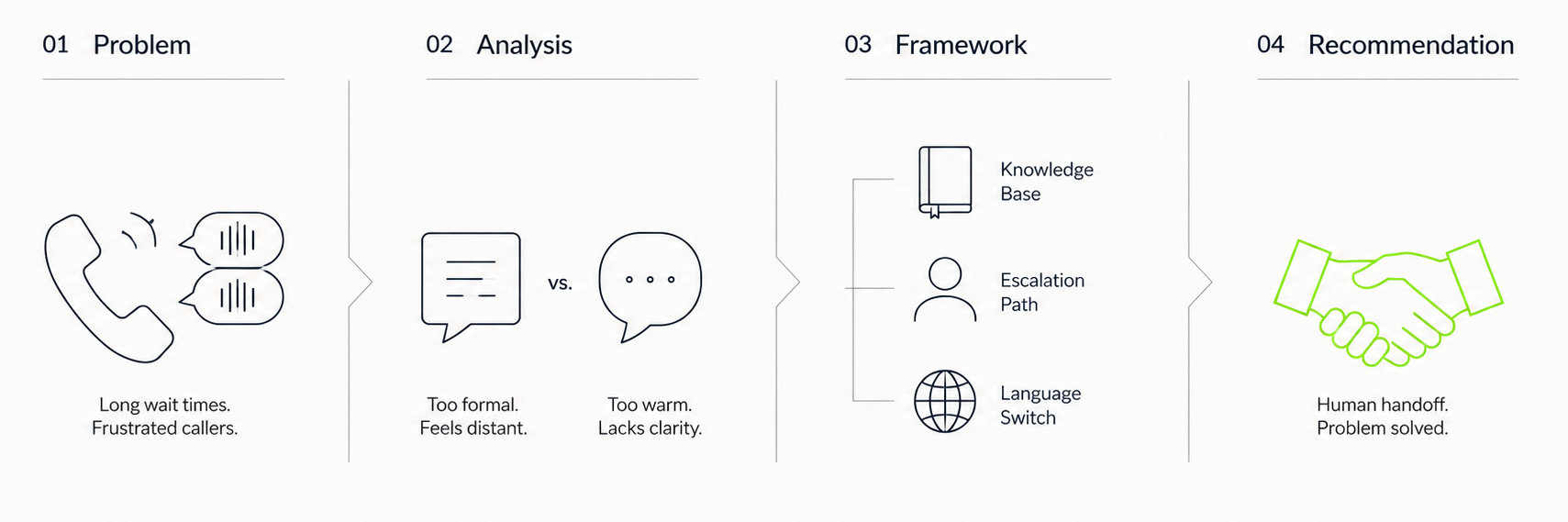
The knowledge base has to reflect the specific business, not a generic script wearing the company’s name. A caller asking about insurance coverage or a treatment price wants an answer tuned to that practice’s actual policies, not a plausible-sounding generality. Escalation rules matter as much as the conversation itself. The system has to recognize a clinical question, an upset caller, or an ambiguous request. Then it routes to a person immediately, with full context. It should never hold a caller in a loop built to avoid a human handoff. For a business serving bilingual markets, language switching has to happen inside the conversation, the moment the caller switches. A menu that forces a language choice up front works against the same goal. [UNVERIFIED — confirm before publishing: we have not independently sourced data on how in-conversation language switching specifically affects abandonment versus menu-based language selection; this reflects design judgment rather than a cited study.]
None of this is a plugin someone installs. It is closer to a decision about who answers the phone and what they are allowed to say. That decision has to be configured against real call patterns and tested against real conversations. It gets tuned for weeks after launch, not switched on and left alone.
The cost conversation leaders should be having
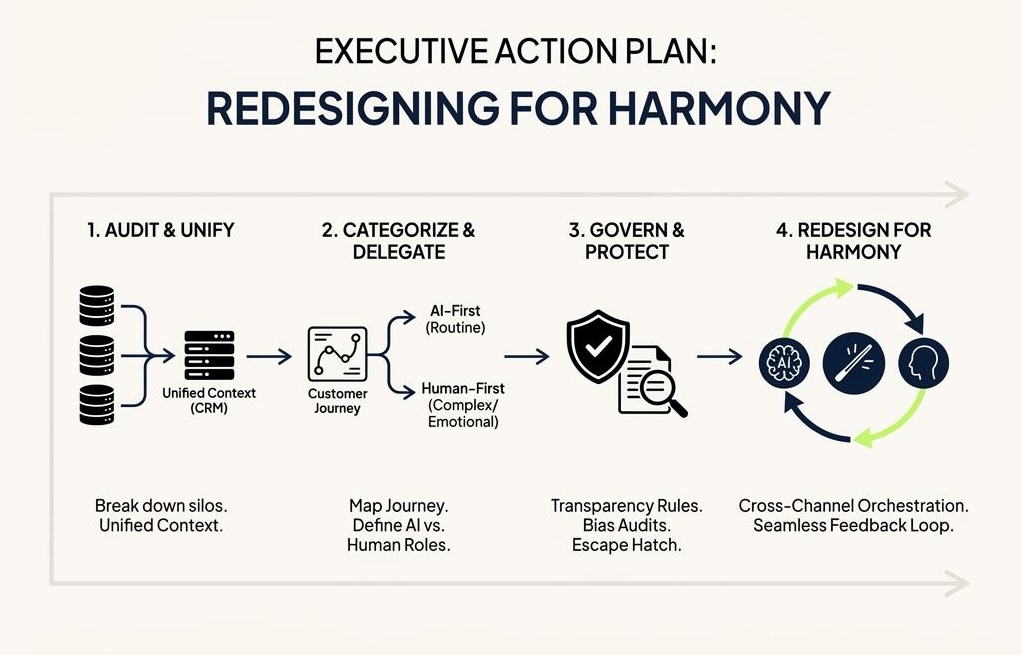
The instinct in most organizations is to treat an AI communication project as a tooling decision. Pick a vendor, turn it on, watch call volume. A more useful frame treats cost discipline as a design principle from the start, not something applied later. We have advised organizations that routed AI workloads to the model suited to each task. Instead of running every request through the most expensive option by default, they matched task to model. That approach cut AI infrastructure costs by up to 70% without reducing what the system could do. The same discipline applies to a customer-facing channel. Origo’s approach to AI adoption treats that kind of routing and tuning as engineering work, not a subscription setting. Designing it correctly up front costs less than a channel customers learn to avoid.
The decision this leaves you with

The question is not whether to bring AI into customer communication. Call volume and after-hours demand already answered that. The real choice is different: is the channel designed to sound like the business speaking, in the caller’s language, with the judgment to bring in a person at the right moment? Or is it a generic tool that saves money on paper and spends down trust on every call? Origo works with a limited number of clients to build and manage the first kind. Escalation rules, a business-specific knowledge base, and disclosure come built into the engagement. The business never has to configure them alone. It is one part of how we approach technology decisions generally: human-centered by design, built to last, and judged on what it does for the people on both ends of the call, not on how impressive the demo sounds.
Schedule a discovery call to find out what an AI front desk built around your practice would sound like. → Book a free discovery call

Ready to explore what AI can do for your team?