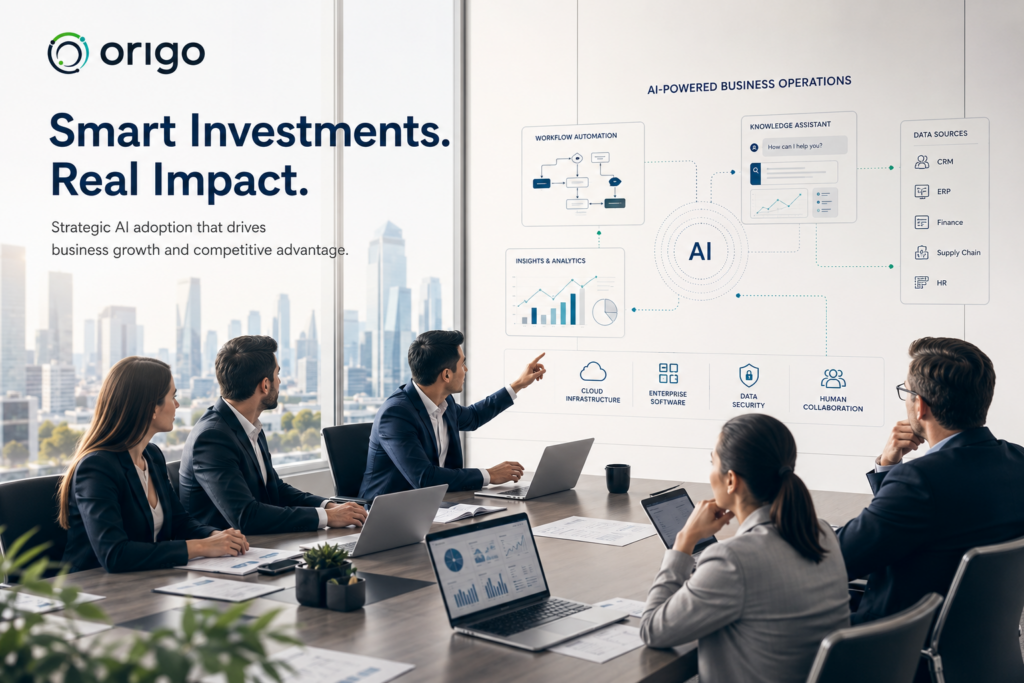
AI is no longer a novelty investment. In 2026, the executive question is not “Should we use AI?” but “Where will AI create measurable value, and where will it quietly drain budget?”
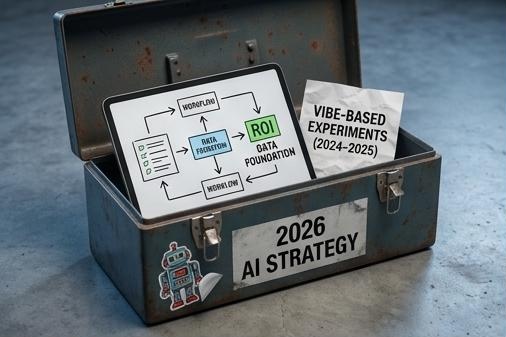
The first wave of generative AI was defined by experimentation: chatbots, copilots, internal demos, and productivity tools. That phase was useful because it helped organizations understand what large language models can do. But it also created a problem: many companies now have AI activity without AI economics.
A 2025 MIT NANDA report, The GenAI Divide: State of AI in Business 2025, found that only a small share of integrated AI pilots were producing significant measurable value, while many remained stuck without clear P&L impact.
At the same time, investment continues to accelerate. Stanford HAI’s 2026 AI Index Report reported that global corporate AI investment reached $581.7 billion in 2025, up 130% from the prior year.
That tension defines the 2026 AI market: massive investment, growing executive pressure, and a widening gap between organizations that integrate AI into operations and those that keep it trapped in pilots.
For business owners and executives, the opportunity is real. But the winning strategy is not to “add AI everywhere.” The winning strategy is to invest where AI improves workflows, decisions, customer experience, and enterprise capability, with governance and financial discipline from day one.

The End of the AI Honeymoon
The early AI adoption cycle was driven by possibility. Teams experimented with content generation, internal assistants, meeting summaries, support bots, document analysis, and coding copilots. Many of those experiments created excitement, but excitement is not the same as return on investment.
In 2026, AI is entering a more mature phase. Executives are asking harder questions:
- Does this reduce cycle time in a measurable process?
- Does it improve revenue conversion, retention, or customer satisfaction?
- Does it reduce risk, errors, or compliance exposure?
- Does it help employees make better decisions?
- Does it scale beyond a demo without creating security, cost, or governance issues?
Deloitte has described this as the paradox of rising AI investment and elusive returns, noting that organizations continue to increase AI spending while many still struggle to demonstrate fast payback.
This is the moment where AI moves from a technology conversation to an operating model conversation.
The Most Promising AI Investment Areas for 2026
1. Customer Experience and Customer Operations
Customer service remains one of the strongest AI investment areas because the work is repetitive, measurable, and directly connected to customer satisfaction and cost-to-serve.
AI can help companies:
- Answer common customer questions faster.
- Summarize conversations and support histories.
- Recommend next-best actions to service agents.
- Route cases based on urgency, sentiment, or customer value.
- Detect recurring problems from support tickets.
- Improve self-service without fully removing human escalation.
Deloitte’s long-running AI ROI research has consistently identified customer service and experience as one of the top areas for AI returns, with reported returns higher than many internal functions.
The executive opportunity is not simply replacing human agents with bots. The stronger opportunity is building an AI-assisted service model where humans handle complex, sensitive, or high-value interactions while AI reduces friction around repetitive work.
Where to invest: customer support copilots, knowledge-based self-service, call and ticket summarization, service quality analytics, multilingual support, and customer journey intelligence.
Where to be careful: fully autonomous customer-facing agents without escalation paths, governance, or brand controls.
2. IT Operations, Software Delivery, and Cloud Modernization
AI is also highly promising inside technology operations because IT teams already work with structured tickets, logs, repositories, documentation, infrastructure alerts, and repeatable workflows.
AI can support:
- Help desk triage and resolution suggestions.
- Incident summarization and root-cause analysis.
- Code generation, testing, refactoring, and documentation.
- Cloud migration planning and dependency mapping.
- Infrastructure cost analysis and optimization.
- Security alert enrichment and prioritization.
AWS has highlighted the need to move beyond pilots and plan AI programs around production readiness, integration, training, ongoing operations, and ROI milestones.
This matters because many companies underestimate the cost and complexity of moving from a successful demo to a reliable production system. AI for IT can produce strong returns, but only when integrated into real development, support, and operations workflows.
Where to invest: AI-assisted service desk, developer productivity, cloud migration acceleration, infrastructure documentation, FinOps, observability, and automated runbooks with human approval.
Where to be careful: disconnected coding assistants without code review, security controls, testing standards, or architectural governance.
3. Knowledge Management and Enterprise Search
Most organizations already own valuable knowledge, but it is trapped across documents, emails, SharePoint folders, CRMs, ERPs, ticketing systems, contracts, PDFs, and legacy databases.
This makes enterprise knowledge management one of the most practical AI investments for 2026.
AI can help employees:
- Search internal policies, procedures, and technical documentation.
- Ask questions across large document repositories.
- Compare contracts, requirements, reports, or specifications.
- Extract insights from historical cases or project records.
- Reduce dependency on informal “tribal knowledge.”
This is where retrieval-augmented generation, or RAG, becomes especially useful. Instead of asking a model to answer from general training data, the system retrieves relevant company information and uses it to generate a grounded response.
However, this area only works when data governance is strong. AI systems need access controls, source traceability, version control, and clear boundaries around confidential information. AWS’s Generative AI Lens emphasizes cost optimization, governance, and architecture decisions for production-grade generative AI workloads
Where to invest: internal knowledge assistants, document intelligence, policy search, legal and compliance review support, technical documentation assistants, and RAG systems connected to approved enterprise data.
Where to be careful: uploading sensitive company information into generic tools without access control, auditability, or data residency review.
4. Sales, Marketing, and Revenue Operations
Sales and marketing can generate attractive AI returns because the outcomes are directly connected to pipeline, conversion, speed, and personalization.
AI can help companies:
- Research accounts and industries.
- Personalize outbound messages.
- Generate campaign variations.
- Summarize customer calls.
- Score leads and detect buying signals.
- Improve CRM hygiene.
- Create proposals and sales enablement content faster.
But this is also one of the easiest areas to misuse AI. Generic AI-generated content can damage brand trust. Low-quality automation can create spam. AI should increase relevance, not volume for its own sake.
BCG has reported examples of companies using generative AI to improve marketing productivity and reduce spend while increasing creative output, including public cases such as Klarna’s AI-driven efficiency improvements.
Where to invest: account research, proposal drafting, CRM enrichment, campaign personalization, content operations, sales call intelligence, and customer segmentation.
Where to be careful: mass-generated content, automated outreach without human review, and campaigns optimized for activity metrics instead of qualified pipeline.
5. Planning, Forecasting, and Decision Support
AI becomes more valuable when it improves executive decisions rather than only automating tasks.
In 2026, one of the most promising areas is AI-assisted planning: finance, supply chain, workforce planning, sales forecasting, demand forecasting, scenario analysis, and operational decision support.
AI can help leaders:
- Compare scenarios faster.
- Summarize risks and trade-offs.
- Identify anomalies in business performance.
- Analyze market, customer, and operational signals.
- Generate decision briefs from multiple data sources.
- Improve forecasting workflows with human oversight.
Deloitte’s AI ROI research identified planning and decision-making as one of the top areas for returns: Deloitte’s AI ROI research identified planning and decision-making as one of the top areas for returns.
The value is not that AI makes decisions for executives. The value is that AI helps leaders see more context, test more scenarios, and make better decisions faster.
Where to invest: forecasting assistants, executive dashboards with narrative insights, scenario modeling, operations planning, finance analysis, and decision-support workflows.
Where to be careful: black-box recommendations without explainability, source traceability, or accountable human review.
6. Risk, Compliance, Cybersecurity, and Governance
AI introduces new risks, but it can also help manage risk when implemented correctly.
For regulated or sensitive businesses, AI can support:
- Policy analysis.
- Compliance monitoring.
- Contract review support.
- Fraud detection.
- Cybersecurity alert prioritization.
- Vendor risk review.
- Data classification.
- Audit preparation.
This area may not always show immediate revenue impact, but it can reduce exposure, improve oversight, and protect enterprise value. For many organizations, risk reduction is a legitimate ROI category.
The challenge is that governance cannot be added after deployment. It needs to be designed into the AI operating model from the beginning.
AWS’s Path-to-Value framework recommends defining business KPIs, impact quantification, implementation costs, ROI metrics, and measurable outcomes as part of the generative AI journey: https://aws.amazon.com/blogs/machine-learning/navigating-the-generative-ai-journey-the-path-to-value-framework-from-aws/
Where to invest: AI governance frameworks, secure internal AI platforms, risk scoring, compliance workflows, cybersecurity triage, and audit-ready decision logs.
Where to be careful: autonomous agents with broad system access, unclear accountability, or no monitoring.

7. Workforce Enablement and AI Operating Model Design
The highest-performing AI organizations do not treat AI as a tool rollout. They treat it as a capability-building program.
This means investing in:
- Training employees on practical AI use cases.
- Redesigning workflows around human-AI collaboration.
- Establishing AI usage policies.
- Creating approved toolkits and templates.
- Measuring adoption and business outcomes.
- Building internal champions across departments.
The Stanford AI Index shows how quickly generative AI adoption has spread, but adoption alone does not guarantee business value: https://hai.stanford.edu/ai-index/2026-ai-index-report
The companies that win in 2026 will not be the ones with the most AI tools. They will be the ones with the best AI operating model.
Where to invest: executive enablement, employee training, workflow redesign, AI policy development, change management, internal communities of practice, and adoption measurement.
Where to be careful: one-time training sessions with no workflow integration, no approved use cases, and no measurement plan.
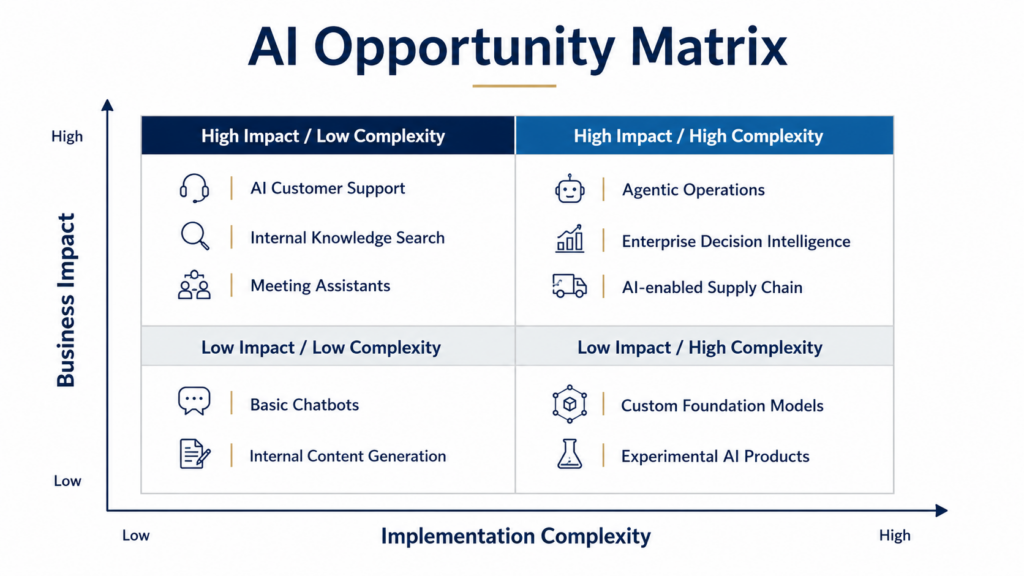
The AI Investments That Often Produce Weak ROI
Not every AI initiative deserves funding. In 2026, executives should be disciplined about avoiding projects that look innovative but do not create measurable value.
Generic Chatbots Without Workflow Integration
A chatbot that answers general questions is rarely enough. If it does not connect to business data, customer history, case management, escalation paths, or measurable outcomes, it will likely become a novelty.
AI Pilots With No Path to Production
A successful demo does not mean the organization has a scalable solution. Production requires security, integration, cost controls, monitoring, support, change management, and governance.
Building Proprietary Models Without a Clear Reason
Most companies should not train foundation models from scratch. For the majority of use cases, the better strategy is to buy or integrate established models, then differentiate through data, workflow design, governance, and customer experience.
Content Automation Focused Only on Volume
AI can accelerate content, but more content is not automatically better. Executives should prioritize relevance, quality, conversion, and brand trust over raw production volume.
Autonomous Agents Without Guardrails
Agentic AI is promising, but autonomy increases risk. Agents that can take actions across systems need permissions, monitoring, approval workflows, rollback mechanisms, and clear accountability.
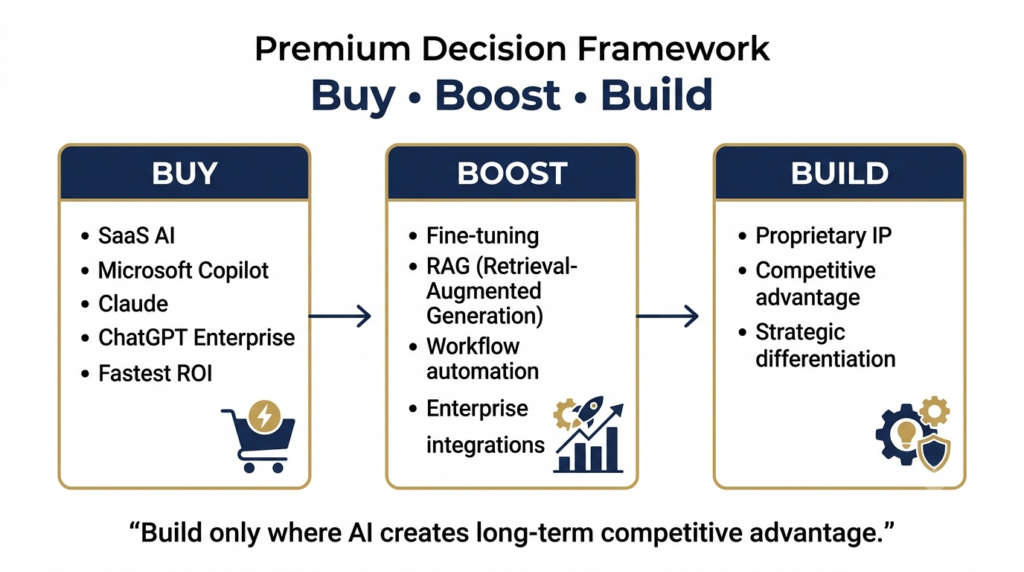
A Practical Framework: Buy, Boost, or Build
For most businesses, the right AI strategy is not purely technical. It is an investment allocation decision.
Buy
Use mature off-the-shelf tools when the process is common and not a source of competitive differentiation.
Examples: meeting summaries, standard productivity copilots, basic content drafting, general analytics assistants.
Boost
Extend existing platforms with company-specific context, workflow integration, governance, and automation.
Examples: CRM copilots, internal knowledge assistants, customer service augmentation, contract review support, cloud operations copilots.
Build
Develop custom AI systems only when the workflow is strategic, proprietary, or deeply connected to competitive advantage.
Examples: domain-specific decision support, regulated knowledge systems, AI-enabled customer platforms, proprietary operational intelligence, specialized agentic workflows.
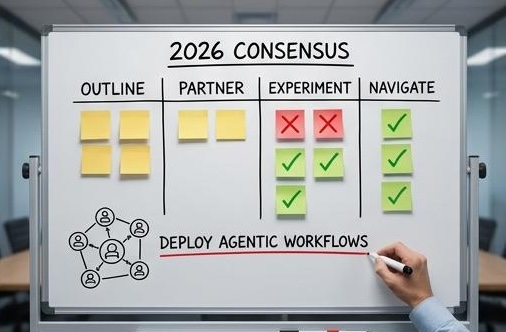
For most organizations, the best 2026 strategy will be a combination: buy commodity capabilities, boost core workflows, and build only where differentiation is real.
How Executives Should Measure AI ROI
AI ROI should not be measured only by usage. A tool can be heavily used and still fail to improve the business.
A stronger measurement model should include four categories.
1. Efficiency
- Time saved per workflow.
- Reduction in manual steps.
- Faster cycle times.
- Lower cost-to-serve.
- Fewer repetitive tasks.
2. Revenue
- Higher conversion rates.
- Faster proposal turnaround.
- Better lead qualification.
- Increased retention.
- New AI-enabled products or services.
3. Risk Reduction
- Fewer compliance errors.
- Better auditability.
- Improved data security.
- Reduced operational mistakes.
- Faster detection of anomalies.
4. Business Agility
- Faster decision-making.
- Faster experimentation.
- Faster onboarding.
- Better access to institutional knowledge.
- Improved responsiveness to market changes.
This broader view matters because some AI investments will not show immediate revenue lift, but they can still create substantial enterprise value.
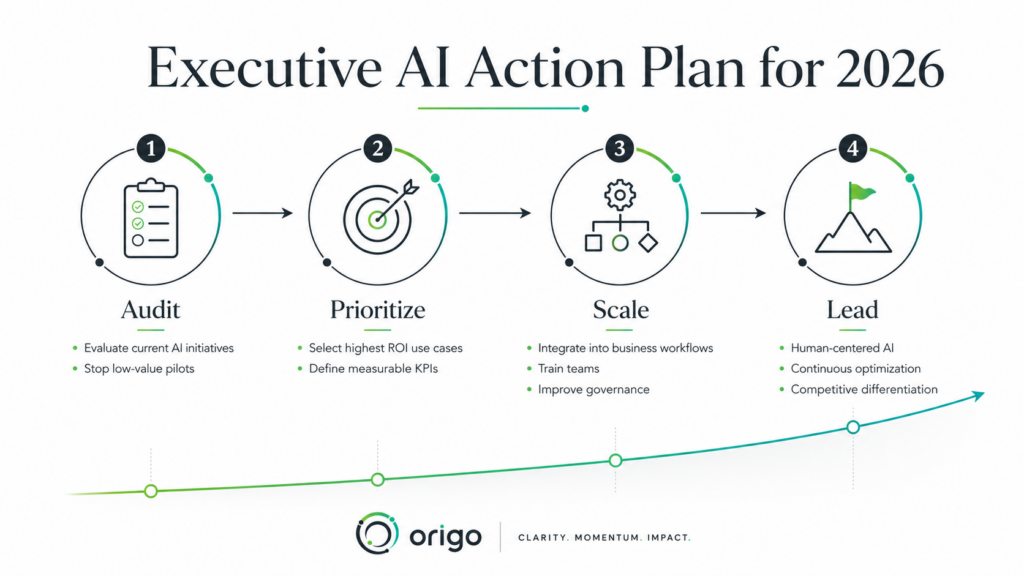
The 2026 AI Action Plan for Business Leaders
1. Audit Your Current AI Activity
List every AI tool, pilot, automation, and informal workflow currently being used. Identify where sensitive data is going, who owns each tool, and whether each initiative has measurable business outcomes.
2. Prioritize High-Value Workflows
Focus on workflows that are frequent, expensive, document-heavy, decision-heavy, or customer-facing. Avoid novelty projects that are difficult to connect to business value.
3. Define the Business Case Before the Tool
Before selecting a model or platform, define the business problem, baseline metric, target outcome, cost model, risk profile, and adoption plan.
4. Start Small, But Design for Scale
Pilots should be narrow enough to execute quickly, but serious enough to test real-world conditions: data access, security, user adoption, integration, and cost.
5. Build Governance Into the System
Governance should include access control, human review, data classification, monitoring, documentation, escalation paths, and clear accountability.
6. Invest in People, Not Only Platforms
AI value depends on adoption. Train teams, redesign workflows, create internal champions, and help employees understand how AI supports their work rather than simply replacing tasks.
7. Review ROI Quarterly
AI capabilities and costs are changing quickly. Review performance, usage, cost, quality, and business impact quarterly. Terminate projects that do not produce evidence of value.
Origo’s View: Human-Centered AI Creates the Strongest ROI
At Origo, we believe the strongest AI investments are not the ones that remove people from the business. They are the ones that help people make better decisions, serve customers faster, reduce operational friction, and focus human judgment where it matters most.
The companies that capture AI value in 2026 will not simply adopt more tools. They will redesign workflows, strengthen data foundations, govern risk, and connect AI initiatives to measurable business outcomes.
The opportunity is not to chase hype. The opportunity is to build an AI operating model that is practical, secure, measurable, and human-centered.
For executives and business owners, 2026 should be the year of disciplined AI investment: fewer disconnected experiments, more production-ready workflows, and a sharper focus on business value.

Ready to explore what AI can do for your team?